FHBC transfers buffalo program to SBT Land Use
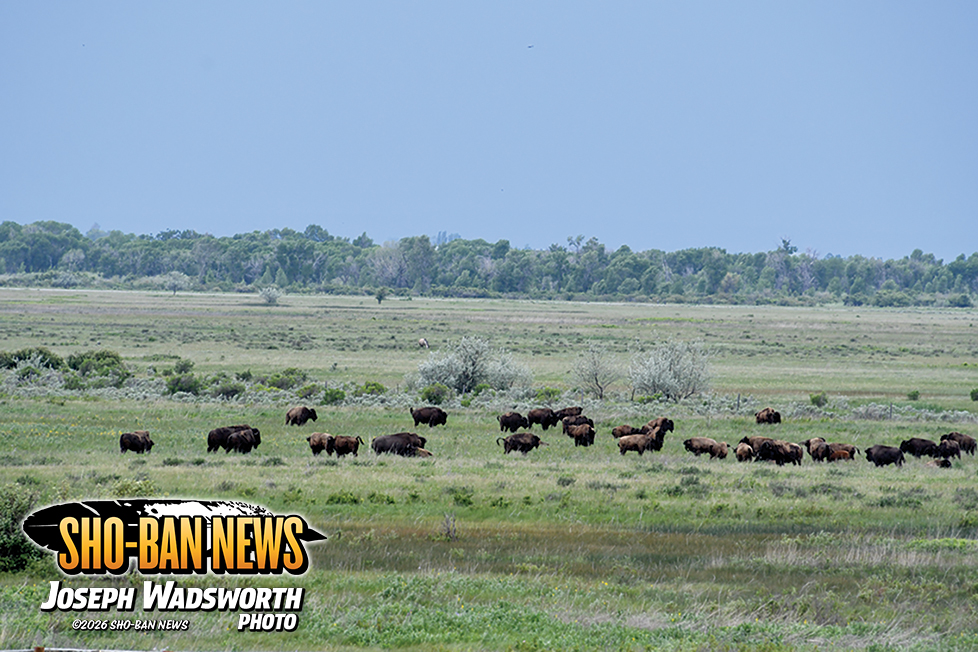
Shoshone-Bannock Tribes buffalo on the Fort Hall Bottoms.
By LORI ANN EDMO
Sho-Ban News
FORT HALL — The Fort Hall Business Council voted February 19 to transfer the buffalo program from the management of the Shoshone-Bannock Agri-Business Corporation to be placed under the Shoshone-Bannock Tribes Land Use Director.
Current staff include Lance Tissidimit, manager, along with technicians Stephan Farmer and Woodrow Teton who will also transfer to the Tribes. In addition, any grants pertaining to the buffalo program and property/assets will transfer.
Tissidimit said he’s been working with the buffalo since 1996 and it fits his lifestyle. “Working with the buffalo they kind of teach you things as you go along in life, he said. “Patience even though they’re not patient but if you’re patient they’re patient.”
The resolution reads the buffalo will be used to provide for the Tribes food pantry, ceremonies, distributions and tribal hunts.
The Shoshone-Bannock herd was established in 1966 with 21 buffalo acquired from Theodore Roosevelt National Park in North Dakota. It’s his understanding the idea was to reconnect with the animal.
Tissidimit said the herd currently numbers are 430 and they roam on about 6,000 acres on the Fort Hall Bottoms and about a 1,000 acres in Ross Fork. Currently the buffalo meat is sold at the Trading Post Grocery store, Buffalo Horn Grill inside the Fort Hall Casino and at the BoHoGoi Café inside Sage Hill Travel Center & Casino. But he’s not sure if it will continue. USDA inspections have to be completed on the meat prior to selling it and it’s difficult to find a location because previous inspection sites they utilized locally quit doing it. Mickelsons in Blackfoot still do the inspections, but you have to get on their calendar and it fills up fast. The next calendar opens in June.
Preston Buckskin, Tribal Land Use manager, said there are a lot of things to figure out and he’s in the process of gathering information. He’s met with the Agri-Business folks and they’re working on making the transition happen. He doesn’t know when everything will be final.
In addition, he needs to have conversations with tribal leadership about food sovereignty and what’s beneficial to the tribal membership.