Fort Hall Business Council considers Cat Creek Energy Project investment
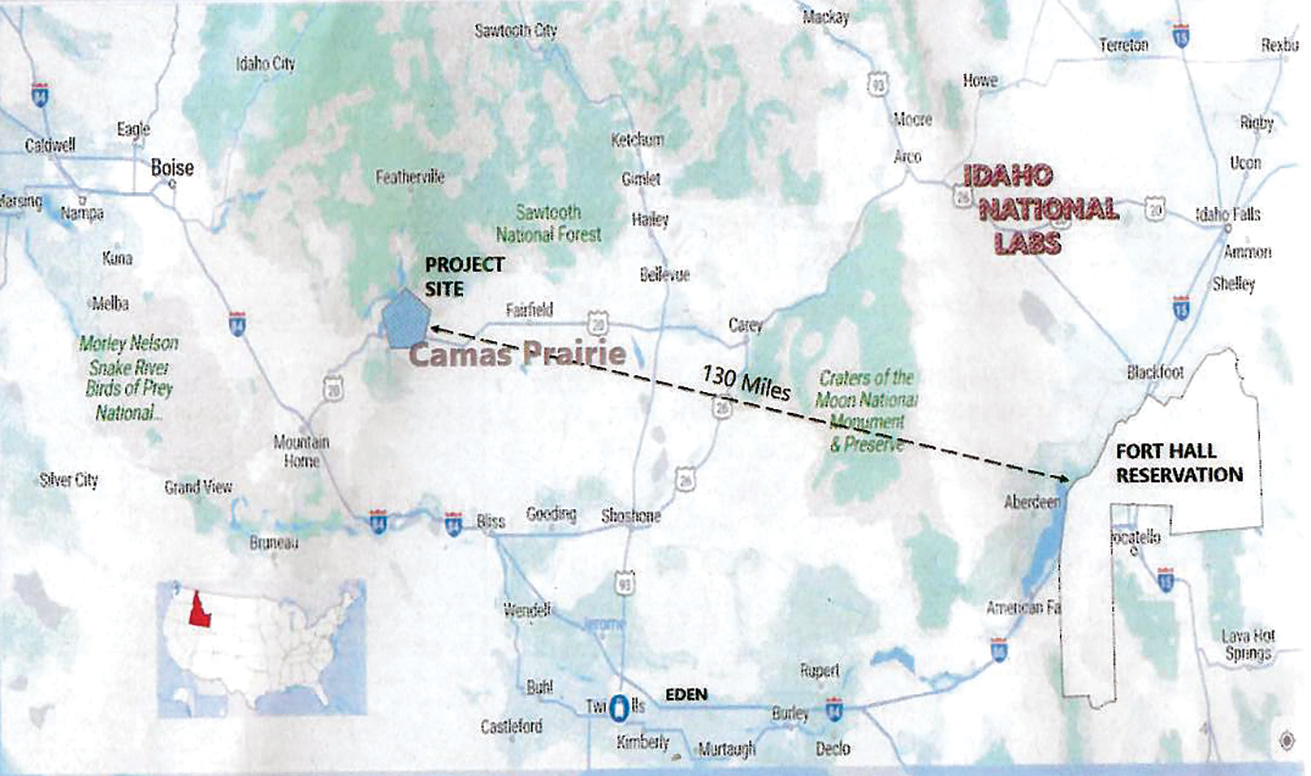
Cat Creek Energy Project site map. (Submitted photo)
By LORI ANN EDMO
Sho-Ban News
FORT HALL — The Fort Hall Business Council is considering a proposal to invest in a partnership with Cat Creek Energy LLC – a $4.5 billion project near Anderson Ranch that is north of Mountain Home.
Cat Creek Energy & Water Storage Renewable Power Station Project is a renewable energy project consisting of solar, wind and hydro where there would be a dam built.
Monte Gray, tribal attorney, is going to the Fort Hall Reservation District meetings to discuss the project in a PowerPoint presentation.
The presentation reads the location is conducive to tribal aspirations. “The Shoshone-Bannock Tribes can help reestablish their presence on ancestral lands through the partnership with Cat Creek Energy,” according what’s listed on the PowerPoint. It reads the project on ancestral lands fulfills a promise of a clean and more sustainable future for the area.
The dam is a 1700 megawatt facility that would make it the 25th largest public power utility in the U.S. Gray said. The Shoshone-Bannock Tribes are being offered 51% ownership in the project and the Faulkner family from around the Jerome area would own 49%.
Funding would come from a loan through the Department of Energy under the Inflation Reduction Act that would allow the Tribes to take a portion of the project back as a tax credit. It gives the Tribes a special status to get a tax credit and since the Tribes don’t have much of a federal tax burden, can take tax credit monies – somewhere between 40 and 60 percent according to Gray depending on what gets approved. It could be used to pay down the cost of the project.
Gray said the proposal is in a review process. A feasibility study is being done on hydrology as water engineers have been hired to determine if it the project will acquire enough water to make it work. In the event of drought, it would still be able to function. Second a feasibility analysis is being conducted for the whole project including the cost. He said if the outcome is positive, it would be an incentive to approve going forward but if it doesn’t, he would recommend against it. He noted it has a lot of potential and expects to produce $100 million a year, however everything is still in analysis stage and undergoing review.
The Faulkner family reportedly has 21,000 acres in the area and have been doing work on getting approvals. Gray said they already have a lot of things in place and came to the Tribes when they realized there was an opportunity after seeing news interviews about the possible casino in Mountain Home. They understand it’s the Tribes aboriginal area with the Camas Prairie nearby. They are offering the Tribes 320 acres of land depending where they want to pick it that could be work one or two million. They are not asking for any other out of pocket money from the Tribes. Gray said the big part is getting tax breaks and the Tribes being a business partner is advantageous to them. The loan with the Department of Energy to do energy projects would get a 2.5% interest rate.
Gray said he’s not sure the project negatively impacts water. Currently Bayer mining company in Soda Springs is offering to purchase power once the project gets underway. Bayer has plans to close down a coal plant. Selling the power would be market driven and it could also be sold to the INL or other federal agencies.
When asked if the tribal membership would have opportunity to vote whether or not to approve the Tribes involvement in the project, Gray said it’s on a fast track for approval.
The Upper Snake River Tribes organization of which the Tribes are represented has send at letter to the Federal Energy Commission that reads they understand with climate change and higher energy demands it’s important to come up with new and innovative ideas. However, they feel very strongly that the new and innovative ideas must be environmentally friendly. The letters reads they review the pre application document as incomprehensive that leaves way too many questions for them not to feel uneasy about the project.
The FHBC submitted a letter of intent to John Faulkner on October 24, 2023 on behalf of the Tribes that reads it’s not legally binding.