'Remembering Bear River' film sheds light on truth of massacre
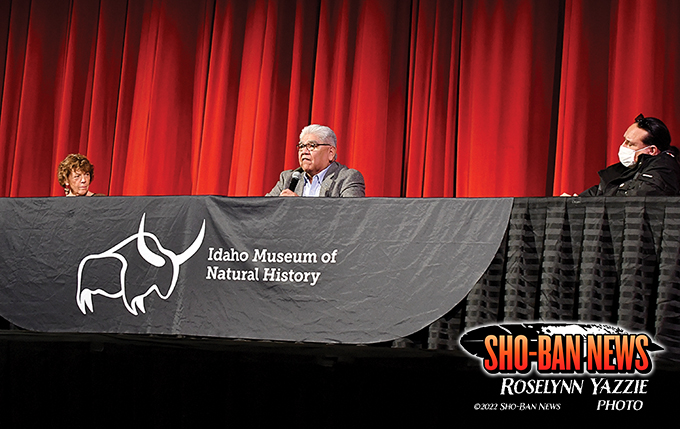
After the screening a group of panelists discussed the significance of the Bear River Massacre. Panelists from left, Dr. Crete Brown; NW Band of Shoshone Chairman Dennis Alex; Fort Hall Business Council Chairman Devon Boyer.
By ROSELYNN YAZZIE
Sho-Ban News
POCATELLO — Idaho State University hosted a screening of “Remembering Bear River,” by filmmaker Phillip Schoen at the Frazier auditorium on Thursday, January 24.
Northwestern Band of Shoshone Tribal Council Chairman Dennis Alex offered a prayer to start the event.
Idaho State University Director of American Indian Studies, Dr. Liz Redd, moderated and read a land acknowledgement statement from the college. She said land acknowledgment statements are a symbolic action and a first necessary, but not sufficient step in healing some of the wounds that have happened in this nation’s history and events like this are action which build on those symbolic words. She thanked the community and partners for making the event possible, including the Northwestern Band of the Shoshone Nation, Shoshone-Bannock Tribes, and the representatives of the cities in attendance, as well as the Idaho Humanities Council and the National Endowment for the Humanities for sponsoring the event.
Redd said they were there to recognize the anniversary of the massacre and learn about the meaning of this event.
She also mentioned since the film was made the monument has been updated and the plaque on the monument reflects more accurately the history of the event, calling it what it is, a massacre.
Schoen was in attendance to speak about the film. He graduated in 2020 with a BA in Film and Digital Content from Studio School in California. He grew up in Victor, Idaho and began working with members of the NW Band of Shoshone when he was still in high school. The film originally aired in 2020 on Idaho Public Television.
Schoen introduced the film and was pleased to see the audience turnout. He was in high school when he first heard about the Bear River Massacre. The process of making the movie took him five or six years to complete.
He said, “It was quite a big undertaking and the more I dove into it the more I realized how important it was and I wanted to do it justice and do the best job I could with this sensitive subject.”
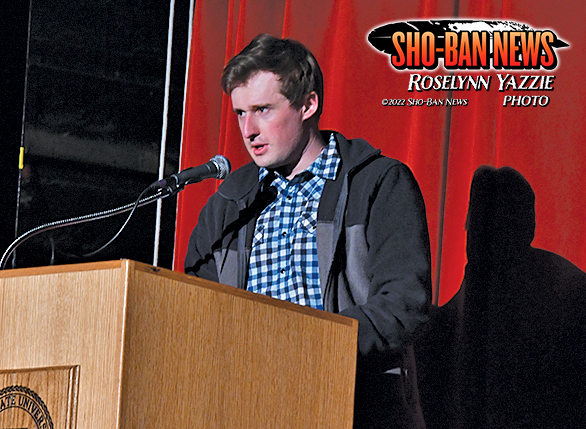
Filmmaker Phillip Schoen speaks.
“Remembering Bear River” is about the 1863 Bear River Massacre, which is considered the deadliest attack on an American Indian tribe by the U.S. military in history. The film explored the massacre and its aftermath.
After the film a discussion panel consisting of Chairman of the Northwestern Band of Shoshone Dennis Alex, Fort Hall Business Council Chairman Devon Boyer, and Dr. Crete Brown, author of “Unsettling the Bear River Massacre.”
The panelists first question was, why do you feel it’s important for Idahoans today to understand the history of the Bear River Massacre?
Chairman Alex said the history should be brought up because the massacre took place during the same time as the Civil War and what happened here wasn’t really news to what was going on back east, therefore making it easy to getting it swept under the rug.
Alex said he couldn’t imagine what it would have been like to wake up to a fight and being instructed to take the women, children and elders to safety.
Chairman Boyer said he grew up being told not to talk about things like this because it can be held against you, but what’s important to understand in the education of all of this is that truth can ultimately be hurtful as it has a lot of pain attached to it. He said the folks that past that day and soon after are the ones that need to be remembered.
He spoke about a man who passed away in the 90s that was a known survivor of the massacre, meaning the event wasn’t that long ago.
Dr. Crete Brown said the Bear River Massacre is an example of western imperialism and what happened to the NW Band of Shoshone and all the Native peoples as well as other marginalized groups happened to the wilderness itself, it happened to everything that could be taken or feared. She said it was a very important subject.
The second question for the panel was how would you like your ancestors for that time be remembered and memorialized?
Chairman Alex the name of the site was changed last month to “Wuda Bogoi” (Bear River), which it will henceforth be known by. He said when he goes there the feeling to him is reverence and is no different than walking into Arlington Cemetery. He appreciated when people find an artifact there they leave it. When people go there he wants them to visualize the sadness that’s there, the humility and the cruelty that was there.
Chairman Boyer says he would hope the learning the truth and understanding that comes with it.
“None of us can change things that happened then, right now, but what can change is how we respect each other. How we learn from this truth,” said Boyer.
“Those folks sacrificed their lives so that we can learn something today,” he added.
Dr. Crete Brown said she researched how other Native cultures have tried to honor their people, such as the Nez Perce, who pay honor to Chief Joseph by reenacting his ride and at Wounded Knee the riders come for several days to the massacre site, making her think what can we do here? For several years she organized a car caravan from Pocatello to the Bear River Massacre site for the memorial representing arriving for a funeral. She would like to see something like that come from the NW Band of the Shoshone.

A scene of the Northwestern Band of Shoshone from the film.
Next, they were asked what they would tell all young people in the country about how they have survived, thrived and not just struggled but grown despite the massacre.
Chairman Alex was told by his grandparents to go to school and learn so they can make it in the world. It’s something he tells his children, because that’s where success lies.
Chairman Boyer said he would hope everybody can learn from that past.
“You have an understanding of life and you want to be a part of it,” he said, adding this is what he would say to no-Natives.
To the tribal youth he would say the same, but in another manner.
“You was born to live a good strong life, because people long before you sacrificed for you,” he said, adding this world isn’t for nonsense, like drugs, partying and alcohol.
“There’s an expectation, you’re to be strong. Make sure your life represents health and happiness. You have an expectation to have your own boho, your own magic, so you can carry on, so you can have purpose and sense in this life,” he said.
Boyer said he knows the world wasn’t just created for Native folks and vice versa and if we don’t understand that first then we’re going to end up doing this thing again and learn nothing.
“It takes all of us to live in this world,” he said.
Dr. Crete Brown said she concurs with Chairman Alex on his perspective of education and said perhaps now educators can widen curriculum and tell the true history.
“We need to work hard on keeping it filled with the truth and the openness that’s required,” she said.
Redd said remembering these stories as examples of not just tragedy but resilience. The Shoshone people are still here, as many still speak the language and practice their culture.
After a few questions and comments from the crowd, the event wrapped up with a reception at the Idaho Museum of Natural History where people were able to continue the conversation.