Sho-Ban journalist & author Mark Trahant honors Native women in new book 'A Century of Ms. Chief'
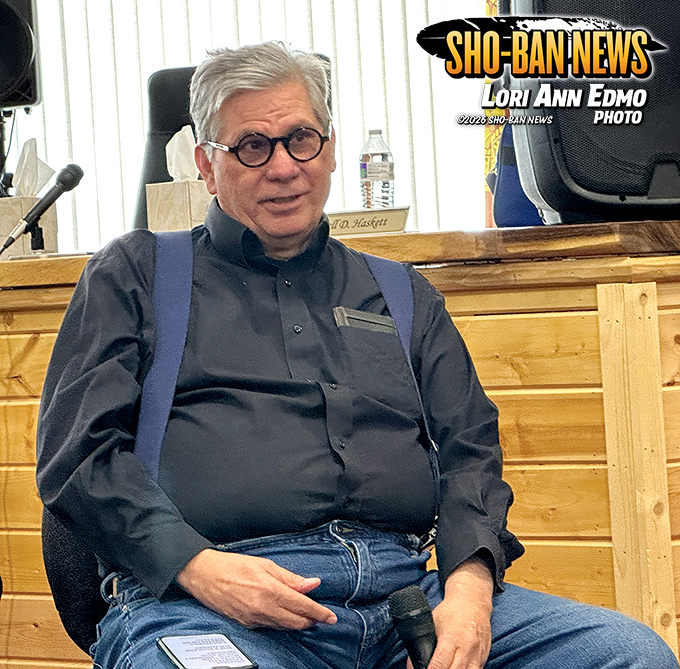
Mark Trahant speaking at Women's History Month event.
By LORI ANN EDMO
Sho-Ban News
FORT HALL — When Mark Trahant started writing his next book, it was going to be an academic book focusing on history, but he said when one looks at the 20th Century, Native women really decided what happened for so many of the “really big events.”
As a result, the Shoshone-Bannock journalist and author’s next book, “A Century of MS. Chief” has a long chapter he calls “the greatest of all time,” and it really focuses on four women – Lucy Covington, Helen Petersen, Ada Deer and Wilma Mankiller.
Mark explained the title came from a meeting he was attending with Mankiller - when a young man came up to her and asked what he should call her, Chief? And she said, “call me Mischief because that’s what I’m gonna do,” and so that’s where the title comes from.
He explained the actual fight involves termination with Covington and Peterson then Deere in restoration. Mankiller also fits into that because she was relocated – she was in San Francisco and her family went through it and decided to return to Oklahoma as part of restoration.
Mark said Covington had a commanding presence and when she asked you to do something, you did it. That showed up in the fight against termination “And that really showed up in the termination fight too because one of the things that I think is really important is that in the late 1950s and early 1960s, she was on the minority on the council, the council was for termination. And they had a chairman by the name of Nicholson, who was out talking to the people about how much money they were gonna get and how important it was for the termination to proceed.” Lucy would follow him around – Nicholson would go to a meeting, give a talk and she would come up afterwards and say “well I have a different viewpoint about this,” and she told it. She also involved prominent people to assist in the fight against termination – Chuck Trimble and Vine Deloria. Lucy started a newspaper called “Our Heritage” and it outlined all the things at stake for the Colville people and what was at stake with termination. Chuck drew cartoons in Our Heritage that portrayed what Colville would have lost if termination happened.
Peterson was Oglala Sioux and Mark said she had an extraordinary background and was a close friend to Eleanor Roosevelt and traveled the world. In 1953, the National Congress of American Indians president was Napolean Bonaparte Johnson, also the chief judge of the Oklahoma Supreme Court - he was for termination and thought assimilation was a good thing. At the Phoenix convention that year, enough funds was raised to open an office and Joe Garry, Couer d’Alene, was elected president and he was anti-termination. He wanted Helen to run the organization, and it happened. She moved to Washington D.C. She organized the tribes to turn the tide against termination and by 1957 or so there was pretty much no tribe on record supporting termination. The Senate never passed anything for termination but the house passed House Concurrent Resolution 208 but it was gone Trahant said, because the House changed because every two years it starts over.
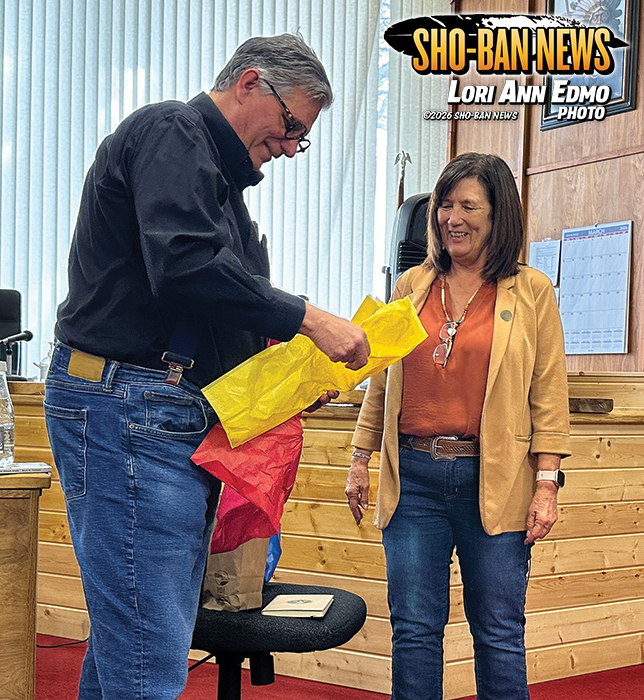
FHBC Chairwoman Donna Thompson presents Trahant with gifts.
The Menominee never agreed to termination, it was underhanded. The tribe had $10 million in the banke when they were terminated – they had a lumber mill and hospital. The hospital closed within a year, the lumber went from being a profitable business to one that was in trouble, Mark continued. The tribe also lost a significant amount of acreage almost immediately because of termination and it was only a ten-year period of time. Deer was attending the University of New Mexico at the time going to law school but she felt compelled to lobby for her tribe. She moved to Washington D.C. spend the next couple of years lobbying and was able to get her tribe restored. Ada ran for Congress and for Secretary of State. Mark said she never won any office but eventually became Assistant Secretary of Indian Affairs under Bill Clinton. Trahant said her work as a social worker and professor at the University of Wisconsin was remarkable.
The last story in his termination chapter is Wilma Mankiller whose family lived in San Francisco as part of the relocation program that still exists today. She moved back to Oklahoma and had a remarkable record of leadership and was awarded the Presidential Medal of Honor. “The Cherokee tribe under her really grew in just phenomenal ways and had such an impact on Oklahoma forever,” Trahant continued. “I think though the most important thing about Wilma's idea of leadership is to push that governments can't be governments alone as built to be about culture so she invested a lot of resources into language programs like that Charlie (her husband) speaks fluent Cherokee and was really involved with that, in fact they kind of had a two-pronged approach he'd be out in the community and then she'd be the one up at the podium working to do things.”
Mark left time for questions with those present asking about Indian Country Today, how it continued, upcoming women leaders, among other topics.
Fort Hall Business Council Chairwoman Donna Thompson presented him with gifts on behalf of the Shoshone-Bannock Tribes.