Sho-Bans in the Spotlight: Sidney Fellows focuses education on camas restoration research & cultural knowledge
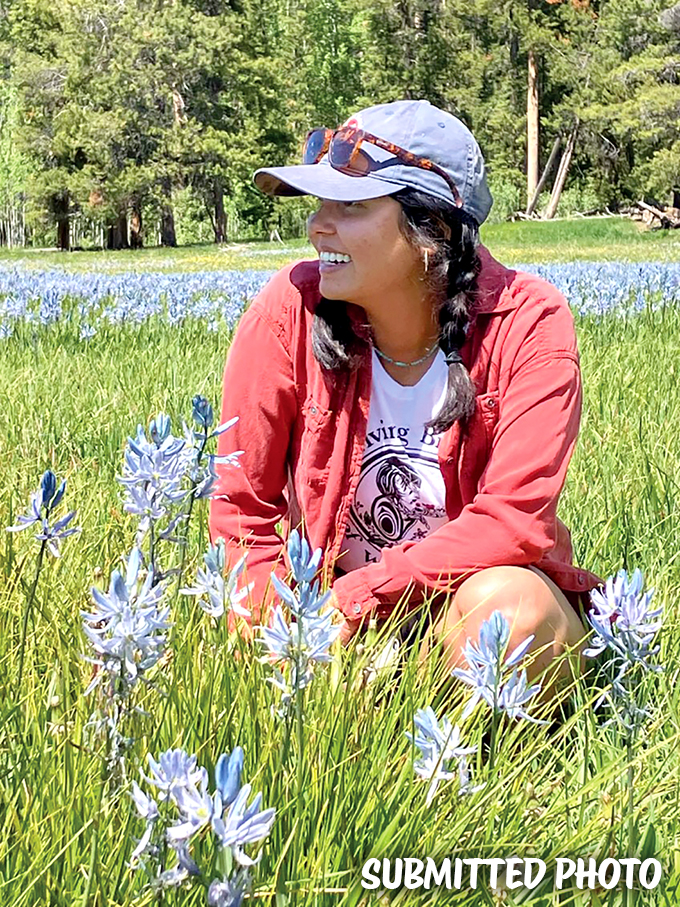
Sidney Fellows gathers camas in Fairfield, Idaho.
By YVONNE WARJACK
Sho-Ban News
FORT HALL — Sidney Fellows, a member of the Shoshone-Bannock Tribes and a graduate of Idaho State University with a degree in Biological Sciences, continues work centered on traditional plants, cultural knowledge, and community-based research, with a focus on camas restoration and education.
She also has a Master of Science degree in Sustainable Food and Farms from the University of Montana in 2024.
Fellows’ connection to traditional plants reflects connections to homelands, cultural teachings, and the role of traditional knowledge within both academic and community settings. Fort Hall has remained a central place in her journey, supporting both personal and academic development.
Her academic path in biological sciences was influenced by family teachings, including stories of her grandmothers working with plants, alongside an interest in scientific and microscopic perspectives. During her time at Idaho State University, Fellows participated in experiences that connected academic study with community-based knowledge systems, strengthening her understanding of relationships between people and the natural world.
She became involved in camas restoration efforts through undergraduate research conducted in partnership with the Language and Culture Preservation Department. The process of reestablishing camas includes seed cultivation along with continued learning practices grounded in observation, care, and adaptation. The work reflects the interconnected relationship between land, culture, and food systems, described as part of a unified system.
Camas holds cultural and ecological significance within Shoshone-Bannock teachings, representing connections to identity and the concept of Sogo Bia, or the Earth. Through this work, efforts continue to support connections between community members and traditional food systems by creating opportunities for direct engagement with the land and participation in hands-on learning.
Fellows’ research emphasizes collaboration with elders and traditional knowledge holders, whose guidance informs both understanding and practice. Land-based experiences in areas including Camas Prairie Centennial Marsh and Grays Lake have contributed to knowledge of camas growth and ecological systems, connecting place-based knowledge with research practices and reinforcing the role of landscape in learning.
Her work remains centered on supporting future generations through the continuation of cultural knowledge and land relationships. These efforts focus on strengthening connections to identity, community, and traditional practices through education, research, and community engagement. She is working with a nonprofit Rodale Institute as an Organic Community Food Systems consultant in partnership with tribal communities, Fellows continues to build on her academic and research experience. Ongoing work includes expanding awareness and supporting continued efforts related to traditional plant knowledge and environmental understanding. Camas remains a central element within this work, described as a plant that brings people together, while broader efforts to protect and revitalize traditional plants continue to emphasize ongoing learning, community collaboration, humility, and care.