Quorum of 180 reached at Annual Meeting; self-governance health care proposal discussed

Tribal members attend the Shoshone-Bannock Tribes Annual Meeting on Saturday, May 10.
By LORI ANN EDMO
Sho-Ban News
FORT HALL — The Shoshone-Bannock Tribes Annual Meeting reached a quorum of 180 eligible tribal voters just before noon May 10 where information was provided on self-governance and two resolutions were approved before the meeting ended around 2:15 p.m. when the quorum was lost.
The meeting began about 10:15 a.m. when veterans brought the flags in and Fort Hall Business Council Chairman Lee Juan Tendoy gave the prayer. Each FHBC member had the opportunity to speak.
Chairman Tendoy said people came from Washington D.C. yesterday to speak on the self-governance issue. Vice Chairwoman Donna Thompson encouraged attendees to take time to listen to Tribal Health presentations, be respectful and ask questions. Devon Boyer, secretary, said there’s a lot of things to talk about even after the meeting. A lot of things happening is because of Trump – he’s ruined a lot of things for others too in the world including veterans.
Ladd Edmo, treasurer, said it’s an honor to be a representative and everything revolves around funding. He said one needs to look at things in a broader perspective. “Newene – without ancestors we wouldn’t be here if it wasn’t for their sacrifice.” He encouraged people to unite as we are all one. The council looks out for the general welfare of the people and they’ve approved the Gaming Revenue Distribution Plan based on the casino’s net profit.
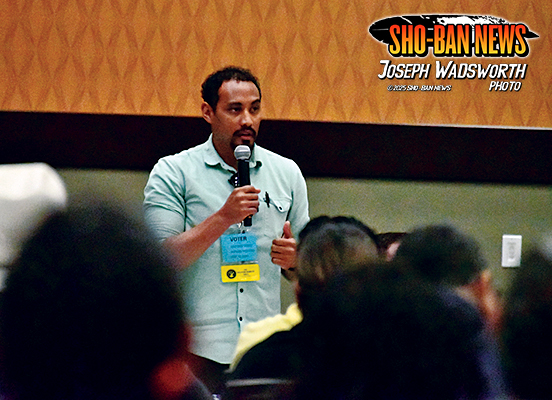
THHS director Travis Martin addresses the membership.
Ronald Todd Appenay, sergeant at arms, welcomed everyone, “We come together to appreciate each other.” He said we get together to figure out what to do, keep to a minimum and realize what is important to our community.
Council member Nancy Eschief Murillo said there are several decisions to be made. Self-governance is a big thing and she’s not acceptable to taking over the Bureau of Indian Affairs programs or the clinic. Concerning major issues, the Tribes have to push so the Treaty is honored. She said tribal members need to let the council know their thoughts. Regarding natural resources and water, need to keep them in place. Regarding the $100,000 the FHBC gave to the Blackfoot Animal Shelter, she believes it should have been less.
The discussion on self-governance where Tribal Health and Human Services (THHS) wants to assume management of the Fort Hall Indian Health Service commenced. Travis Martin, THHS director, said there are three entities THHS, Indian Health Service and Community Health when talking about self-governance. Martin introduced Jay Spaan, Self-Governance Communication and Education Tribal Consortium executive director, who said the consortium is a tribal driven initiative offering technical assistance. Under self-governance the Tribes would identify their own needs, create new programs and he said it would improve efficiency. There are 385 tribes operating under self-governance. He said the Shoshone-Bannock Tribes have contracted some programs for decades. Regarding Treaty rights, he said it doesn’t alter it in any way.
Rebecca Patterson, an attorney with Sonosky, Chambers, Sachse, Miller & Monkman’s Anchorage office, said the Tribes could build upon and implement Title 1 contracts or Title V compacts. She said the Tribes have the option to use federal employees, federal supply sources and use GSA vehicles.
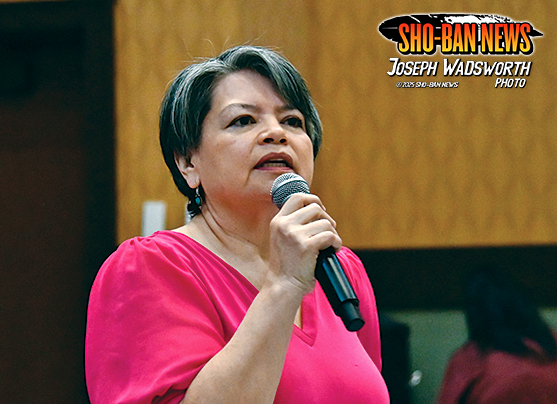
Jill Whitekiller speaks.
Questions and comments from the audience were next. Wesley Edmo has concerns and believes there needs to be a medical proforma. He wants to know the projected revenue and also how many other tribes are we serving in the clinic. How many Sho-Bans are actually served?
Russell Haskett said the Tribes have taken over some programs, “We are not doing great with some programs,” for example Purchased and Referred Care, some of his bills are not paid. There are a few rough spots, but some are working pretty good. “I feel like the non-profit guy is trying to sell a used car.” Spaan replied he’s not selling a used car, it’s an option.
Martin said PRC is going uphill, “We have the option to bring more providers, more options here all under self-governance.”
Twila White Bear said we are a sovereign nation, we have rights – you can’t break the Treaty and we have to stand behind it. She asked what about the people not from here as many are married into our tribe. Have to pay for own health care when one goes off the reservation. She said a lot of things need to be looked at before 638 and need reports. “I would like to stay under IHS,” she said. Responsible people need to be in the positions, she continued. She wants to see numbers and asked if the Tribes could be trusted? More information is needed and “we need to stand together for our rights.”
Spaan said 41 out of 43 tribes in the northwest are under self-governance.
Mike Sherman said more information is needed that flows evenly. He understands what’s to be offered but there is a lack of communication. He wants to know where the funds come from.
Lisa Hevewah said she’s against Travis and Norma’s decision as she believes they have no idea how to run an outpatient clinic. There’s a high rate of diabetes and they (the Tribes) took the money for the diabetes program noting in the past there was podiatry but now she doesn’t see it happening. She asked why not contract with specialists to come to the clinic? She accused them of being power hungry. She told the council members they’re voted in to make decisions but alleges they listen to tribal employees who want power. She asked who they work for and she said us. She said the council isn’t doing their jobs and what are they doing to our health care? She doesn’t trust them. “Health care means a lot to me, it’s in my heart,” Hevewah continued, noting we are going to get a HRSA clinic.
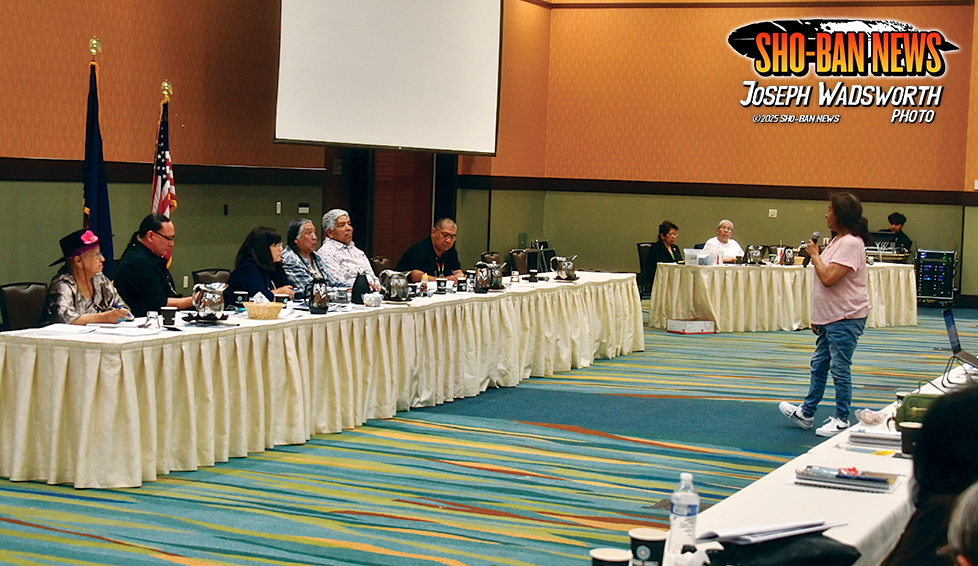
Lisa Hevewah addresses the Fort Hall Business Council.
Martin said they’re just bringing the information and the Tribes have been doing 638 contracts since the 70s. He believes they can make things stronger.
Jill Whitekiller is a nurse, but now works in the insurance industry. Two years ago, she wouldn’t have supported self-governance but since that time the presidential administration has changed, is running amuck, threatening our treaty. “We are talking about a limited pot of money, it’s not our tribe’s responsibility to negotiate with IHS,” she said. Under self-determination tribes take care of selves and get to choose how to spend the money. IHS supplies physicians, they’re trying to get by, “we need the power, health care should be most important factor and we have opportunity to do that.” She said if the Tribes do 638 can still get that money. She would love to have a long-term care center for elders. There’s a lot of administrative overhead and should be using Medicare and Medicaid. Looking forward there’s no guarantee IHS exists. “If we want to stay strong then take that responsibility,” she continued. What will we leave for our children and grandchildren, she asked. She thanked the people who came here to share their expertise. As a nurse she’s for health care, it’s an opportunity and is a necessity. She’s sharing insight from health care perspective.
Nathan Small said he’s aware of a tribe that did self-governance, but they were isolated. He doesn’t believe THHS will make the revenue they’re talking about. If people have Medicaid or Medicare they’ll go to town for health care. He believes improvements need to be made, be less dependent on insurance. “This won’t work here, we are not isolated,” he said.
Louise Dixey said she’s heard the presentation about seven times at district meetings and other locations. She’s yet to hear the long-term goal of prioritizing health care. There needs to be assurance what type of income it’s generating. Within tribal government there’s a long-term need of how the Tribes is spending money, for example in the council meeting the other day the casino spent $1.5 million on signage. She believes the Tribes need to be more accountable for the money we have now. An investigative audit is needed. There’s a need to keep revenue sources accountable. Language and culture need to be a priority, need to contract Realty and it’s important to take of landowners.
Gaylen Edmo said one of the worst behaviors is when there’s opportunity and it turns into personal attacks. He sat in on Tribal Health updates when on the tribal council and many staff have been there for years with the best interests at heart. He said the council is doing their jobs bringing the issues up – say thank you to the council and staff for bringing it forward.
Claudia Washakie is Purchased and Referred Care manager and said the program receives $7 million under a 638 contract. A lot of people rely on PRC, a lot rely on their health insurance, but it doesn’t always pay. Combined, the PRC staff has 70 years of experience in health care. The only thing they’re not paying is for IHS staff wages. When people say the Tribes aren’t ready for self-governance, the Tribes have been doing it for some time, she said.
Ferdinanda Shay questioned why take over something that is already working? She used to be employed at the Indian Health clinic and said Tribal Health doesn’t provide for diabetes and cancer patients such as it did before. She said it all comes down from the top. She asked why the FHBC did the dog pound donation, do I look like a dog, she asked? She just found out the issue is being voted on.
Melissa Hevewah asked why the Tribes don’t allow IHS to bill the Tribes insurance? Martin said it’s tribal funds that is why they can’t bill it and Louise Dixey said it’s self-funded insurance.
It was determined 180 people were present at 12:08 p.m. so Chairman Tendoy called the meeting to and FHBC roll call was done. Administrative secretary Billie Appenay read the May 6, 2023 minutes. Gaylen Edmo made the motion to approve and Tami McKnight seconded it. The minutes were approved with 96 in favor, zero opposed and no abstentions.

A tribal member motions to cast vote at the Annual Meeting.
Vice Chairwoman advised those present Trump’s proposed budget cuts $900 million from Indian Health and proposes condensing the Bureau of Indian Affairs. Fort Hall Agency employees received letters May 9 to either retire or resign. She said it’s scary and has a heavy impact on us.
Ferdinanda Shay asked what will happen to leases and advised the FHBC should be advocating for the tribal membership. Thompson replied they are and the Tribes are members of national organizations.
Resolutions
Voting on resolutions began, there were six submitted but only two voted on before the quorum was lost. Resolution A was regarding minor trust fund accounts to provide each account holder with itemized financial performance statements including the Salazar trust accounts with the data provided in a timely manner. It will include investment objectives, total distributions, fees and tax status. Audrey Ballard made the motion to approve with Louise Dixey seconding the motion. Dixey said the resolution should be amended to strike the Commissioner of Indian Affairs since the position no longer exists. The vote was 60 in favor and 21 opposed.
Ladd Edmo said the Tribes have an investment policy to protect investment dollars. Parameters need to be established because when money is invested one has to be smart about it.
Wilma Teton said there is concern about money being taken out of investment account and tribal members want accountability. Ladd Edmo said there are two types of child accounts – one is Salazar and the other is gaming.
Resolution B involved protecting the safety of families and children that establishes within the Tribal Law and Order Code and Indian Child Welfare chapter defining the federal guidelines for implementing protocol notifications from states regarding Indian children who have been taken into state custody, removed from their family and placed into foster care or adopted. The resolution also reads a “stand alone” ICWA (Indian Child Welfare Act) office shall be established to guarantee the protection of our children. The ICWA office shall be staffed to include a designated contact for states to notify regarding children who’ve been taken into state custody. The office will maintain records of all children returned to the jurisdiction of the Tribes and those that are still in state custody. Zannita Fasthorse Pongah made the motion to approve and Ferdinanda Shay seconded the motion. The vote was 75 in favor and 11 opposed, no abstentions.
Evelyn Small questioned whether Social Services already does the work. Wendy Farmer agreed and asked why there was a need for it? She said there is not enough foster parents on the reservation.
Marina Fasthorse said Social Services is different than ICWA.
Yvette Towersap agreed there are issues with the Social Services office and the council needs to demand for improvement. She agrees with Wendy Farmer there’s not enough foster parents and the Tribes need to do more to support foster parents. Her concern is if it would add more confusion?
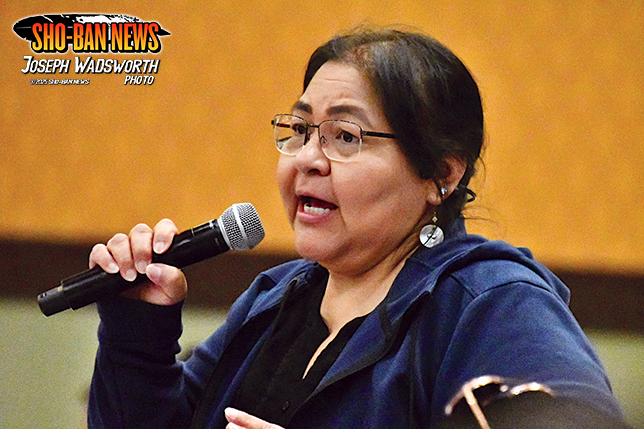
Yvette Towersap discusses Social Services issues.
Iralene Osborne said she raises her grandchild and couldn’t get help locally. It took her two years to get a birth certificate and Social Security number.
Gaylen Edmo said as along as P.L. 280 is in place the Tribes will continue to have ICWA issues because the state assumed seven area of jurisdiction and it muddied the waters. He worries there would be a duplication of services. He asked if the resolution is implemented how will the Tribes deal with it. Dan Stone, executive director, said it would probably be under THHS – it is a specialized area and need to be consistent – focus on how and where children are placed.
Lalana Navo said she represented ICWA cases when she worked at Social Services and the problem was there were no foster homes. There are ways to get around it.
Marina Fasthorse said she works directly with child protection cases and families only get $300 per month even if there is more than one child. With a stand-alone department, people can get the services. When she attended the State of Idaho foster care meeting there were only three Natives in attendance.
Vice Chairwoman Thompson agrees with ICWA, “Shame on us for not having foster homes – we need to get out and encourage our families and take care of our families.”
Ellen Ball agreed there needed to be an ICWA department.
The meeting ended at 2:16 p.m.