No quorum at SB Tribes Annual Meeting; FHBC updates membership
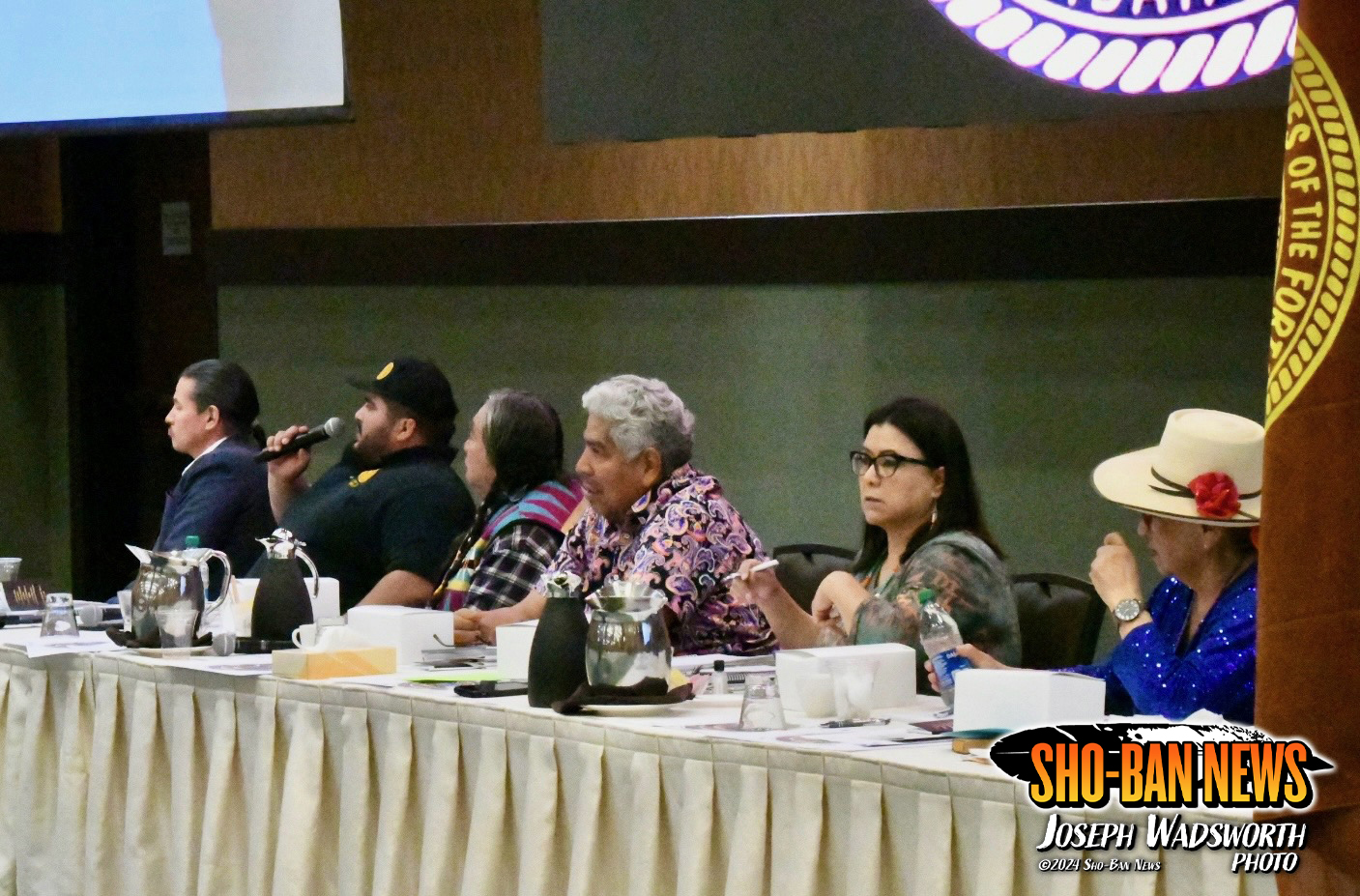
Fort Hall Business Council members give their reports at the Shoshone-Bannock Tribes Annual Meeting on Saturday, May 11, 2024.
By ROSELYNN YAZZIE
Sho-Ban News
FORT HALL — Shoshone-Bannock tribal member attendance peaked at 145 with a quorum unmet at the Annual Meeting on Saturday, May 11.
The day began by honoring veterans and posting colors before the event.
Fort Hall Business Council (FHBC) in attendance, Chairman Lee Juan Tyler; Secretary Claudia Washakie; Treasurer Ladd Edmo; Sgt. of Arms Gaylen Edmo; Council Members Sammy Matsaw Jr. and Nancy Eschief Murillo. Vice Chairwoman Donna Thompson was absent due to attending her granddaughter’s graduation.
FHBC gave updates, starting with Chairman Lee Juan Tyler, who talked about his trip to Washington D.C. last week. He gave testimony on behalf of the Tribes and met with lobbyists from Mapetsi and U.S. Representative Mike Simpson. They talked about issues concerning the Gay Mine high wall, although it shut down in 1993 it’s been a long-term process to reclaim it and clean it up. This is something they want to work on along with the Environmental Protection Agency and Bureau of Land Management, although it takes a long time.
They also addressed law enforcement and the lack of funding. Under the BIA guidelines they’re supposed to have 25 officers and only have 14 currently. Tyler said that’s hard, especially on weekends only having a few officers trying to respond to calls across the reservation. He called it a life and death issue happening all over Indian Country. They asked for better pay for the people due to safety concerns, after they're trained they find better-paying jobs and leave. Tyler inquired about cadet programs and wants to see more youth train to learn how to protect the people. He said it’s hard because some see the police as the enemy, which is portrayed across America in the media.
Road maintenance was another issue as the pavement condition is bad, as well as the gravel roads, making it another life and death concern for first responders to access.
“At this day and age we should have good paved roads for everybody,” he said. Additionally, they’re underfunded.
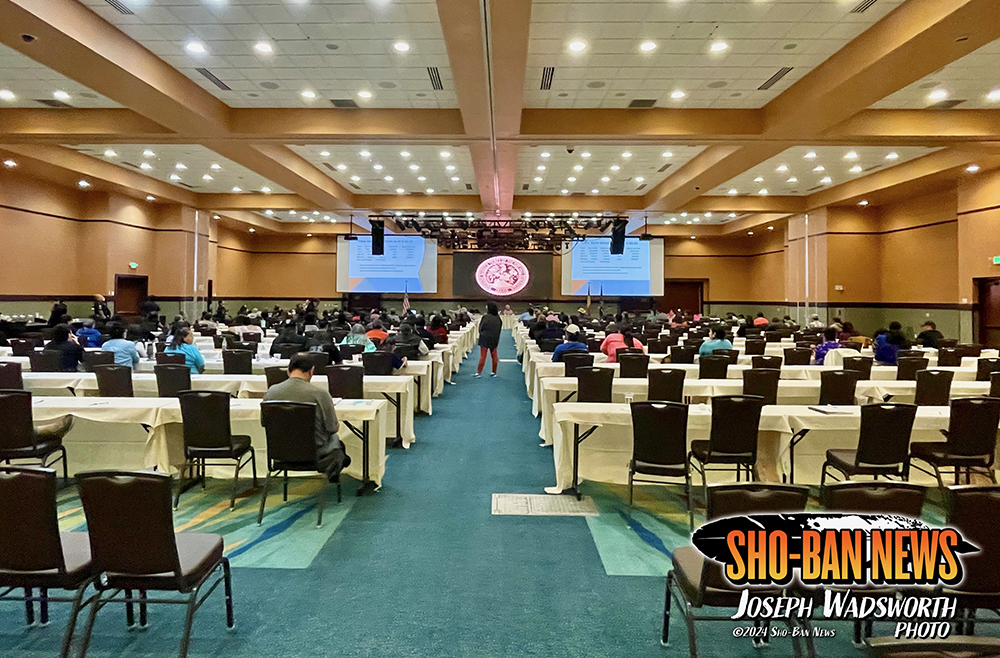
Only 145 tribal members attend the Annual Meeting, failing to reach a quorum.
Another issue was the boundary of 1873 when the reservation was at 1.8 million acres to Malad. Survey errors reduced it to what it is today. Tyler said they’re working to get land restored and are hopeful since other tribes have done it. But it’s still another long process.
Tyler said life goes by fast and they’re trying to get things going for the future as the past leaders did.
“We, as the council, want to do what’s best for our people, even though some might know it, some don’t. It’s a tough situation,” he said.
Treasurer Ladd Edmo said it’s good to try to convey the message all the time and the challenges to try to help people understand change.
“We go through a lot of changes. You see it evidently in life and our tribal departments, with leadership as far as managers, directors, employees, across the board. So we take pride in our Tribe when we’re advocating for it because we have the casino with over 700 employees. We have the Tribes with over 800 employees, so a lot of livelihoods rely on the Tribes, and when you try to make these changes that are devastating to the process it makes it challenging. Some of these changes are towards federal funding, which we do receive,” said Ladd.
They also receive state funding and sometimes donations from companies or organizations they call NGOs. The federal funding part requires that reports are made and guidelines are followed, so it’s hard to make a change that affects those funding agencies and burdens understaffed departments like Contracts and Grants, Finance Office, and down the line.
Ladd said he’s learned a lot and everyone asks him as a treasurer if he has control of the money, but he doesn’t as budgets are gone over by all of the council and there’s a process to it.
He talked about the Tribe’s revenues that come from tribal leases, right of ways, and other opportunities that involve the tribal land. Tribal members also have leases, which give them their lease income, Concerns people have are why their lease goes down, which is potentially caused by fractionation.
As Treasurer, Ladd said it’s been challenging, but it’s been interesting and fun to learn.
“By no means I am not an accountant. I’m just in a position to be able to kind of watch, and help, and guide, and make sure that we’re following our budget,” he said. “We’re always thinking about the future generations and that’s what it’s all about, protecting and preserving for our future.”
He added, that the June per capita payment comes from the Gaming Distribution Plan and all the money comes from the gaming operations, the net profit that averages about $38 to $40 million. This year is lower than last because of the freeway traffic that may have limited it. Forty percent of the $38 million is what is being distributed this year. The numbers are similar to last year, and each year is different.
Before the meeting continued, Thomas Mendez offered a prayer.
Secretary Claudia Washakie thanked everyone who showed up. She has served on the FHBC for the last two years and it’s been a learning experience. She’s enjoyed her time assisting tribal members with their needs and meeting on subjects that pertain to the Tribes.
She said for the individuals who would like to learn more about the grazing income during the Bannock Creek Meeting this month on May 29, they’ll have the ARM Manager come out to describe exactly what happens with the grazing, including an explanation of the BIA’s new accounting system.
Washakie currently serves as the delegate for the FHBC to the Northwest Indian Portland Health Board. She’s attended meetings and has seen one of the current problems going on in the fight against fentanyl. Fentanyl has hit Indian communities hard and is a synthetic opioid that drug dealers have been cutting their drugs with and is deadly in a lot of cases.
“It’s unfortunate that it’s happened and it’s happened here on our reservation as well,” she said.
The majority of the time when someone overdoses there are a lot of other elements that play into their death, they can asphyxiate from choking on their vomit, or they could have a heart attack, but it’s all attributed to the drugs in their system.
Washakie said the Indian Health Service does have $250 million they’re currently trying to obtain for the Northwest Tribes to help with the opioid problem.
“I’ve been attending these meetings because in the northwest there are 46 tribes that comprise of the Indian Health Board. Of those 46 tribes, there are only six tribes that still have an Indian Health Service Clinic in operation. All the rest of the tribes have gone to a 638, or what they call self-governance, where they assume that funding for the tribal health services would normally go to a health service clinic within their area. So those tribes have taken on that responsibility of providing health care to their tribal members instead of giving it, or having the funding go to the Indian Health Service,” she explained.
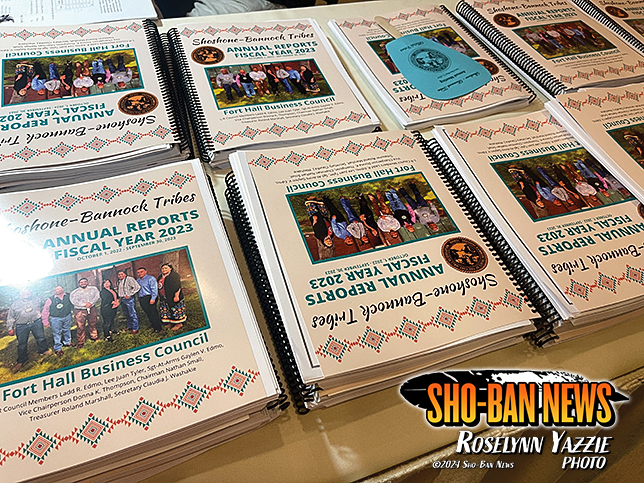
Annual Report packets given to Shoshone-Bannock tribal members.
In October the Shoshone-Bannock Tribes will be one of four. A lot of the tribes in the northwest are small and landless. The last meeting she attended was last month in Jamestown, Wash. where membership consisted of 514 people and they had no land in trust. They bought land with their land base at 1,500 acres.
Washakie said she attends the meetings because she doesn't want small tribes to dictate what's allowable for the Shoshone-Bannock Tribes. After all, it’s important to be at the table making determinations for our tribal memberships.
The majority of the tribes still holding on to their IHS facilities are the large land-based tribes.
Washakie said we have IHS, Tribal Health, and HRSA that provide our health care needs and that’s important because not every tribal member has insurance.
Washakie said the Sho-Ban Tribes can probably provide health care needs or insurance for the tribal members through the PRC dollars, and that’s something she’s hoping more individuals will participate on the current tribal health board so they can address the issue.
Sgt. of Arms Gaylen Edmo said it was unfortunate they weren’t at a quorum yet as the Annual Meeting is one of the most important of the year because it's the memberships meeting and the chairman’s meeting. He understands it’s his job to support the chairman and field any questions from the membership.
He felt it’s important to get on with the new business, specifically the legal updates as the membership should understand the legal issues before us and how they’re unfolding.
Gaylen said he’s happy to be attending and thankful for the membership showing up. He’s looking forward to a good meeting with a good discussion.
Council Member Sammy Matsaw Jr. gave a broad overview of his experience. He has a newfound respect for the tribal leaders, those currently serving, and those who have served.
He said it's a complex job, coming into it as a salmon ecologist who has learned a lot from salmon are a complex species.
“There’s a lot of legalities and legal issues going on around them, but at this level, that gets amplified by about 10 times, if not more. So I really appreciate being here. I’m very happy to see everybody and I'm happy to update you guys and give everybody the information that you need to hear about all the things we’re doing up here and all the things that are happening within our community with everybody that has a part to play in that,” he said.
Council Member Nancy Eschief-Murillo was hopeful they would get a quorum as it’s critical. She took office in June 2023 and says it’s been interesting sitting on this particular council. She’s served prior on the FHBC in 2001 and held other offices. She called the new office pretty restrictive and has only gotten on one committee, which was a designation to a Tax group, which looks to generate more funding for the Tribe. She was appointed to the Tribal Enterprise Board and said it’s an extremely important position as they have five board members who have the authority to work with the Enterprises, as well as the agricultural aspects for the Tribes.
“It’s interesting that the council, still has their apron strings are not cut yet. I believe if we’re going to thrive and flourish these Enterprises need to have the authority to go forth and seek funding. The membership, council needs to also assist in their development,” said Murillo.
She thinks a computer chip industry will be good for the Tribes so they can learn how to do the microchips and so forth.
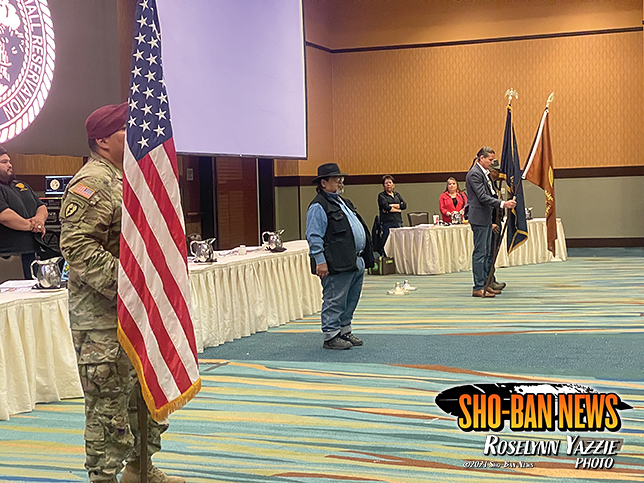
Local veterans post colors before the event.
Murillo said Wadda Farms has a tremendous packing plant in Pingree and it was offered here on the reservation, but the council at the time did not go with it.
A tire company also wanted to set up some businesses here and that council didn’t go with it.
“We need to tap into these particular commercial businesses to employ our people, to have our people have good jobs, good-paying jobs. So there are things this Enterprise can be doing,” she said.
Murillo said economic development needs to be a stand-alone so they can thrive and get it done. She continued to say gaming is great, because it generates money and employs people, but it also doesn’t employ some people who would like to work because maybe it’s something they just don’t want to be involved with and there needs to be diversity in employment.
Another thing Murillo has noticed over the years is the Tribe attempting to do the casino project at Mountain Home and said it’s a whole other issue in itself. The 157 acres will probably get into a trust, which was purchased with the Tax money, and said there should be a Tax Commission to assist in how the tax money is going to be developed. T.P. Gas, Sage Hill, and all the gas businesses the Tribe has generate gas tax and they also generate cigarette tax, which also assists in some of the programs.
“The point being here is the Tribes can generate more money and that’s what we need to look at. We need to look at self-sustainability, because if we ever get terminated by Congress and the way the political atmosphere is – we have to be ready,” said Murillo.
She continued, “We need to get some things done here. To get every one of you and all your families sustainable; housing is critical. Critical. It’s hard to get housing. If you don’t have any land it’s worse yet. So there’s a lot of things that have to be taken care of and I’d like to see the membership be into the council more on some of these task force committees that the council has more or less provided to the operations, or suggestions. They’re run by employees, whether they're non-Indian or Indian. I would like to see tribal members on these committees,” she said.
Murillo also talked about the drug situation and the squatters. She sees a need for treatment centers to get people help, even if they’re addicted, which makes it hard for them to make good decisions, even though it hurts everyone.
Attendance declined after lunch but discussion resumed.