Importance of learning Bannock history, leaders emphasized at 2026 gathering
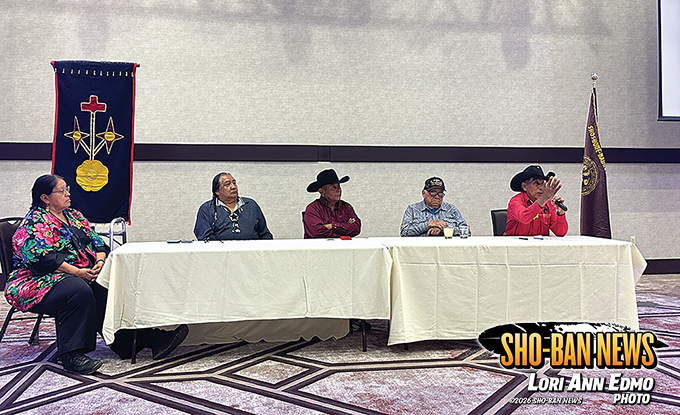
The panel for Bannock War history at the annual Bannock Gathering on August 3.
By LORI ANN EDMO
Sho-Ban News
FORT HALL — The Bannock Gathering is important to all Shoshone-Bannock tribal members to remind of the fact Bannock warriors involved in the Bannock War fought to preserve our traditional food.
In addition, the warriors fought the Umatilla and Cayuse in the Blue Mountains and Chief Taghee assured a reservation was secured in his homeland. Louise Dixey, Language and Culture Preservation Director, emphasized it August 3 at the Shoshone-Bannock Casino Hotel.
“That’s why the Bannock Gathering is so important — as for our language, the Bannock language is so descriptive and we don’t have very many language speakers left, even Shoshone, but I have confidence that our languages will survive,” she said. There are several young people learning the language and they love it so it’s encouraging to her.
Dorsey Plentywounds did the opening prayer in the Bannock language. Fort Hall Business Council member LeeJuan Tendoy gave a welcome urging people to enjoy themselves, along with then Miss Shoshone-Bannock Myke Moore who also encouraged attendees to learn during the event.
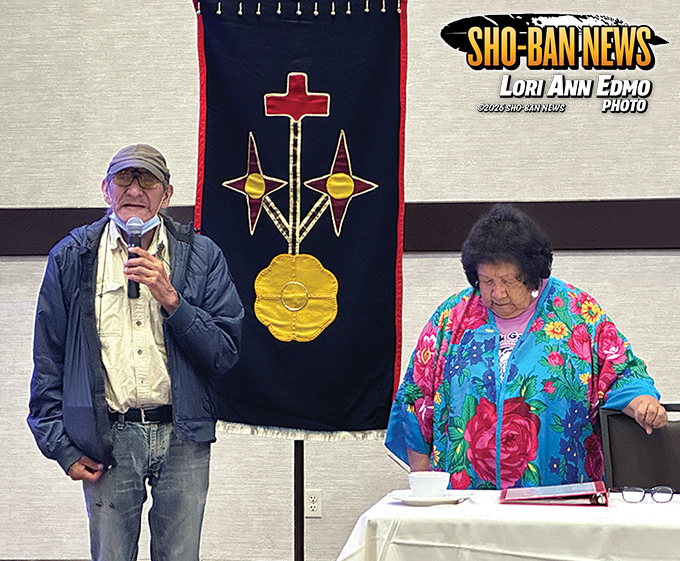
Dorsey Plentywounds gives the morning prayer in Bannock.
Velda Racehorse did a PowerPoint presentation on Chief Taghee who was signatory to three treaties involving the Shoshone-Bannock Tribes including the Fort Bridger Treaty of 1868. He was born in 1830 and passed away in 1870. His parents are unknown, and the location of his birth is unknown. Taghee had three known wives and six known children. He traveled with his Bannock people during the annual gathering and hunting rounds. He became familiar with the ways of his people. His siblings include Susan Tadpole’s mother, Tosahkagiu’s mother was his sister. Bannock John was married to one of his sisters. In addition, Bannock Jim, brother to Bannock John was also married to one of Taghee’s sisters.
Racehorse explained the events leading up to the signing of the Fort Bridger Treaty of 1868. In 1867 at an informal meeting, Taghee insisted on a right of way for his people to travel when going to or coming from the buffalo country, along with going to the white man’s market with their furs and skins. He wanted the right to camp and dig roots on the Camas Prairie when going to Boise City to trade. He noted some of his people have no horses so they could remain at the Camas Prairie while others go on. He wanted to go the buffalo country where he will gather with his tribes and tell of the arrangements he could make. Taghee was willing to go on a reservation as the white man proposed but it would be in the spring.
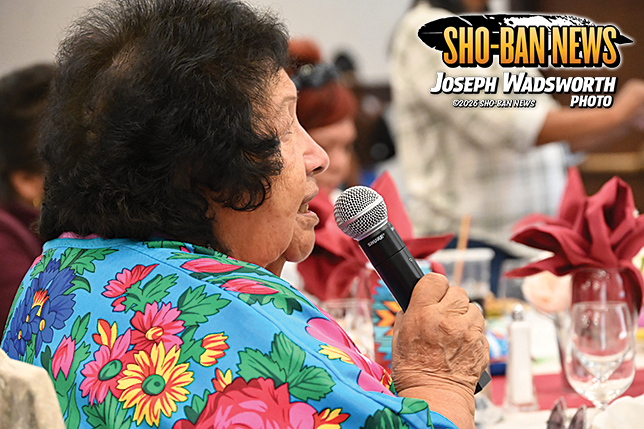
Tribal elder Velda Racehorse speaks about Chief Taghee at the Bannock Gathering.
The Indian Peace Commission sent General C. Auger to negotiate a treaty with the Snakes and Bannocks as well as the Eastern Shoshone under Chief Washakie. “It is agreed that whenever the Bannocks desire a reservation to be set apart for their use, or whenever the President of the United States shall deem it advisable for them to be put upon a reservation, he shall cause a suitable one to be selected from them in their present country, which shall embrace reasonable portions of the ‘Portnuef’ and ‘Kansas Prairie’ countries and that when this reservation is declared the United States will secure to the Bannocks the same rights and privileges therein…”
Taghee grew up to be a warrior, War Chief, and overall chief of the Bannocks. He signed three treaties -the 1863 Soda Springs Treaty, the 1867 Long Tom Creek Treaty both unratified then the Fort Bridger Treaty of 1868 that was ratified and recognized to today. He raised a family, supported them through annual gathering of food sources, along with his Bannock followers.
Racehorse said in her presentation Taghee was noted as a strong willed, patient and intelligent leader trusted by his own people and the U.S. government.
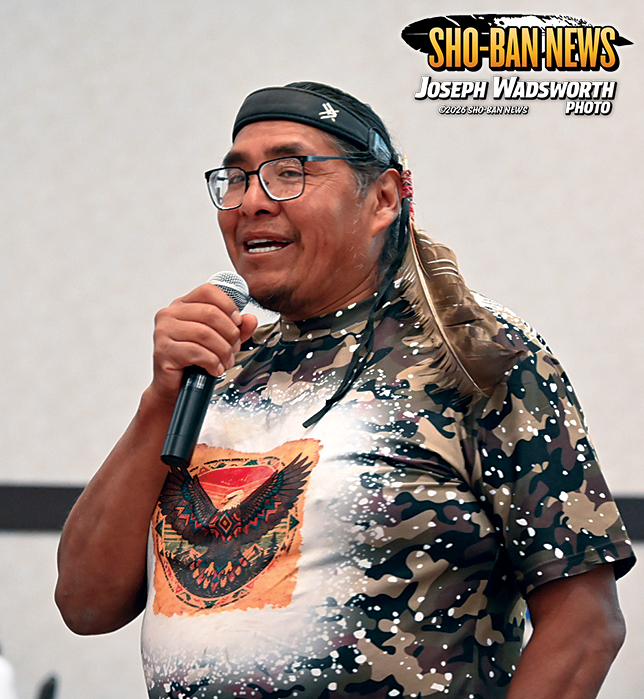
Angelo Teton speaks to Bannock Gathering attendees.
Zelphia Towersap and Mardell Butler were up next with a presentation on Indian names from 1900s Census Records. Butler said she’s 48 years old and still learning the language and feels good about it. They wanted to talk about the Indian names – when they were looking through government records. Despite hundreds of pages, they went through one year and picked out some names – four Shoshone and four Bannock names. The Bannock names include Oha-tim-natse or Yellow Rock Boy, Peowinne or Big Man, Pe-sha, ya-gwon-e or good and Tw-win-ah or tewene standing. The Shoshone names were Wah-ham-bay-kay or killed twice or guess second in a game, Too-muzzo or black beard, Yangwatsy or Yakwatsi or cute little frog and Ingatuah or Aingatua or red son. They matter because today there are still Indian names in our tribal community – the names are still carried on within the families. They also shared similarities of words between the Bannock and Shoshone languages.
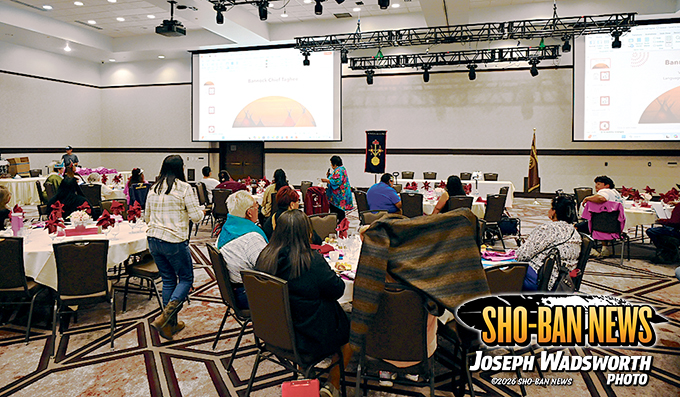
Bannock Gathering attendees listen to history presentations.
Louise Dixey followed with a presentation on the Bannocks and the Camas Prairie first providing definitions on gathering rights – Inherent Rights – existing in someone or something as a permanent and inseparable element, quality. Inherent Right is a right of an individual from birth. Treaty Rights – Article 4 Fort Bridger Treaty of 1868 - the Indians named herein agree when the agency-house and other buildings shall be constructed on their reservations named, they will make said reservations their permanent home, and they will make no permanent settlement elsewhere; but they shall have the right to hunt on the unoccupied land of the United States so long as game may be found thereon, and so long as peace may be found thereon, and so long as peace subsists among the whites and Indians on the borders of the hunting districts. The Fort Bridger Treaty of 1868 is a ratified agreement between the Shoshone-Bannock and the United States signed July 3, 1868. It’s a peace treaty not a cession agreement -no lands were given up. Article 4 guaranteed the right to “hunt on all unoccupied lands of the United States.” The Treaty guaranteed a reservation for the Bannocks as Chief Taghee stated. Shoshone and Bannock headmen were called to Fort Bridger to negotiate the Treaty terms.
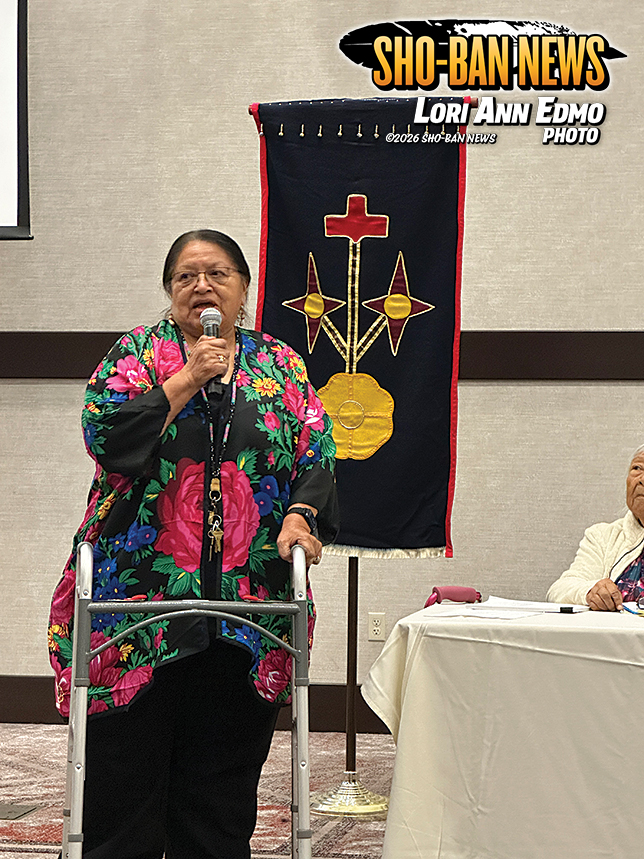
Louise Dixey speaks to attendees.
Camas Prairie is tamme teviwa (our homelands). In Shoshone and Bannock pasigo and tsuga are the words for camas. The Great Camas Prairie in modern Camas County holds an important place in Shoshone-Bannock history and life. The Camas Prairie is much more than a food source for Shoshones and Bannocks. The Camas Prairie is a gathering place at the crossroads of our extensive regional trade network. Each year in late May and June Shoshones and Bannocks by the thousands from extensive ranges converged on the prairie as the camas came into bloom. Some Shoshone and Bannock groups remained on the Great Camas Prairie throughout the summer.
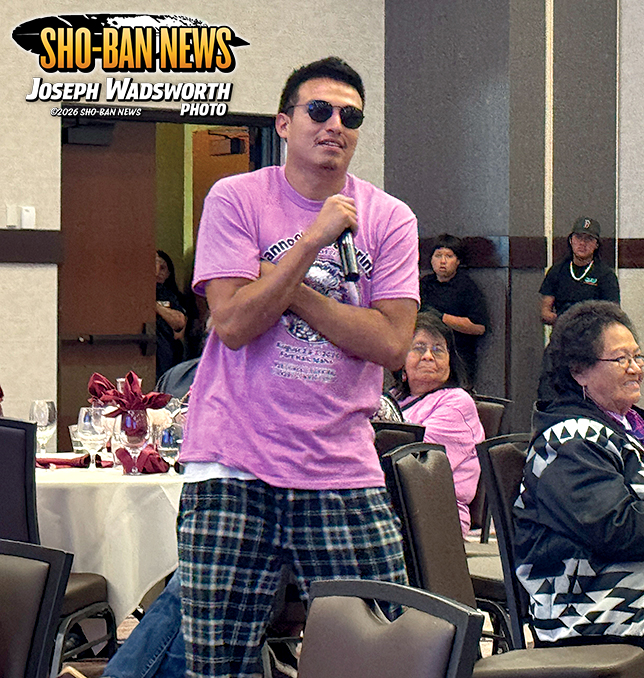
Virgil McCormick speaks to gathering attendees.
In the presentation, Dixey said within two years of the Treaty signing white settlers were encroaching upon the Great Camas Prairie in substantial numbers and tensions were on the rise. Particularly distressing were the herds of hogs driven on the prairie to fatten on the camas roots. Government officials did nothing to either curb the damage or mark off a reservation. In his 1871 annual report, Fort Hall agent Montgomery Berry referenced the difficulties between certain white men who have occupied a portion of the prairie. Tay-to-ba and A-wite-etse. Two Bannock headmen and Treaty signatories reminded the agent the prairie was reserved for them by the Treaty. Because of the encroachment, the Bannock War began.
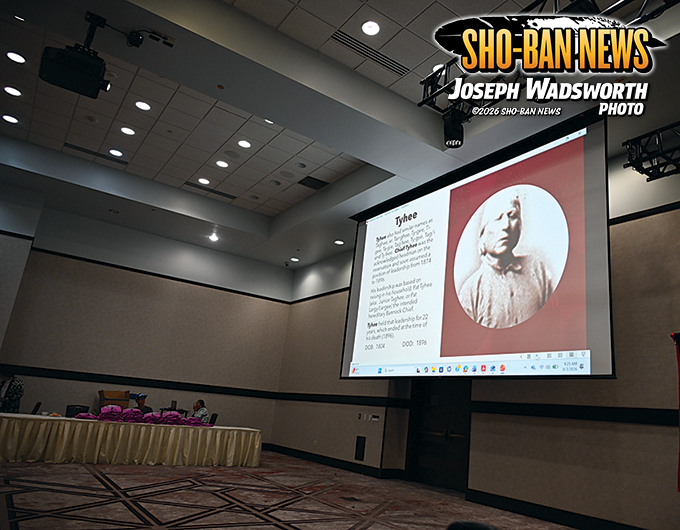
A presentation on Chief Tyhee at the Bannock Gathering.
A tribute was done in honor of Wayland Bonatsie naape who recently passed on as he had much knowledge about old songs including the Horse Dance song and history. LCPD staff showed a video of the horse dance from the Fort Bridger 150 acknowledgement.
During lunch, then Miss Shoshone-Bannock contestant Tay’a Osborne introduced herself telling who her parents are Gifferd Osborne and Rachel Snipe. She answered questions from the audience. She believes youth need to learn more of our ways and continue with our language. She intends to keep balance in her life. She’s been asked to run for the title since was 18 but didn’t think she had the mindset to run at that time. She said she wants to honor her huutsi (paternal grandmother) in running for Miss Sho-Ban.
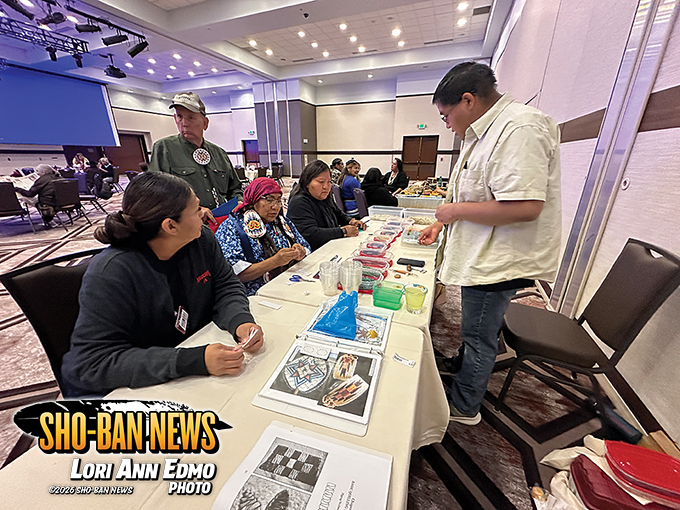
Dillin Diggie instructs on quillwork.
A video Lizzie Boyd created of the Bannock Warrior Challenge was shown and Warrior Challenge participant Virgil McCormick was present to talk about his experience. He said he never kayaked before, so it was different. “Everyone fighting and competing in the water was nice. Seeing all the warriors and trying to get in front was awesome.” And when he headed out on the bike, “I didn’t remember how to ride a bike,” as he made everyone laugh. The other participants started getting away from him. Then he had to get up on his horse and he saw nobody ahead of him. “By the time I was running, it was already finished,” he said. It’s more of a faster pace and he intends to work on figuring out the bike part of things. It was way different. “There’s a lot of strong warriors here, you know, in the community,” and he enjoyed going up against them. “I just want to commend them on their training and all the work they put in the horses. It was awesome,” he concluded.
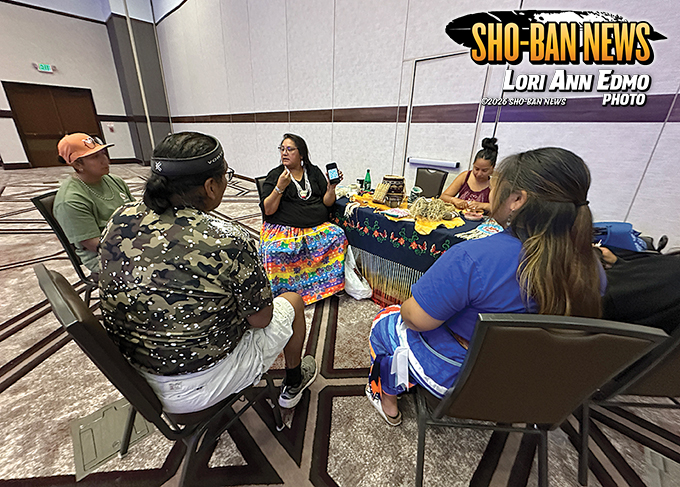
Bobette Haskett does a presentation on basket making.
Dixey said the Warrior Challenge and Youth Warrior Challenge shows what it takes to be mentally and physically strong just like our ancestors.
After lunch a panel discussion occurred on the Bannock War where panelists Lee Juan Tendoy, Brian Thomas, Lionel Q. Boyer and Delmar Kelly discussed their perspectives. Much of it was about oral history they were told and family ties.
Three workshops followed with Bobette Haskett teaching weaving, Dillin Diggie instructing quillwork and Marlene Duran teaching how to play traditional card games.
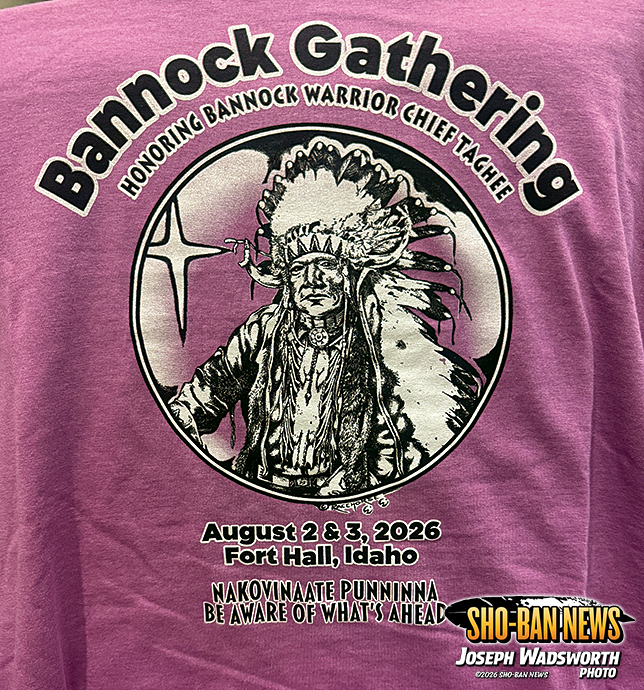
The T-Shirt design for the Bannock Gathering.