FHBC Vice Chairman Nathan Small attends COLT conference to discuss bison protections
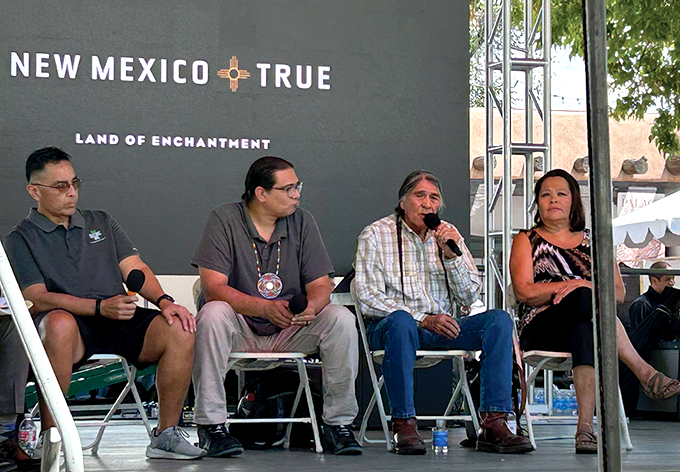
FHBC Vice Chairman Nathan Small speaks at the COLT conference. (Office of Public Affairs photo)
By MICHAEL STEELE
Tribal Policy Analyst
SANTA FE, N.M. – Fort Hall Business Council Vice-Chairman Nathan Small traveled to New Mexico from August 13 to 16 for the Coalition of Large Tribes’ (COLT) quarterly conference.
COLT leads advocacy efforts for tribes with over 100,000 acres of land. Its growing influence has led tribes with smaller land-bases to seek non-voting membership and join COLT’s advocacy efforts.
Hosted by the Southwest Association for Indian Arts, COLT heard presentations from a variety of agencies and organizations. This included hearing from the National Science Foundation about funding for Science, Technology, Engineering and Mathematics (STEM) education, the Federal Communications Commission (FCC) about expanding broadband and other services, and MedenRX, a company that provides telehealth and pharmacy solutions to expand access to care.
Candidate for New Mexico governor and former Secretary of the Interior, Deb Halland, made an appearance and emphasized the importance of tribes in local communities and states.
Robust discussion about protecting bison took place as the federal government continues to change rules to favor cattle. Presenters emphasized that Tribes don’t raise bison like cattle, and the audience added that the COVID-19 epidemic and recent temporary lapse in SNAP benefits revealed that bison remain key for food sovereignty.
Small explained that Fort Hall maintains a herd of over 600 bison. However, the Tribes still have the right to graze the animals on federal lands. He requested that tribal grazing preference on treaty lands be added as a topic during future consultation. “We shouldn’t have to fight for that right,” he added.
Other discussion topics included tribal water rights, taxation, tribal air and water quality standards on reservations, tribal courts, utility rights-of-way, and employing tribal expertise in land and forest management. Presenters also emphasized that tribal voices must be included in conservation for Yellowstone, proposed developing a “Bison corridor” for free grazing, highlighted the importance of voting, discussed protecting the Black Hills, addressed threats to “Section 106” reviews required in the National Historic Preservation Act, and discussed the storage of nuclear waste.
During the conference, Small participated in a panel about the treatment of sacred places where he had the opportunity to educate a large, captive audience about governmental failures protecting sacred sites generating applause as he emphasized the need to accurately teach native history in the classroom.
Afterword, several members of the audience expressed their appreciation to Small and expressed that they had no idea about current risks to sacred sites.
Vice-Chairman successfully proposed a resolution for COLT to oppose legislation allowing the J.R. Simplot company to expand its Superfund site south of the Don Plant despite the Tribes’ Treaty rights. The resolution unanimously passed and tribal leaders expressed their willingness to provide letters to congressional leaders opposing the legislation.