Various issues addressed at Idaho Council on Indian Affairs meeting in Boise September 15
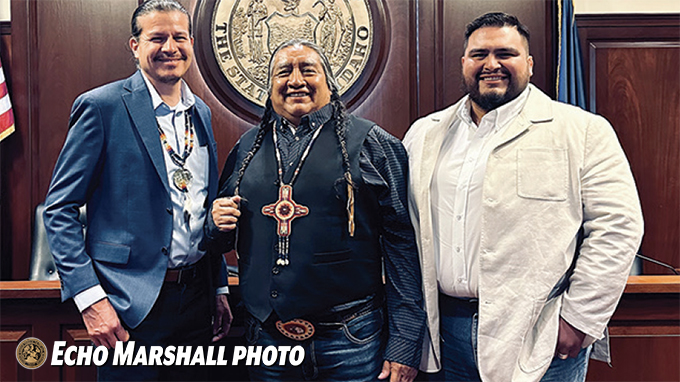
From left, FHBC members Sammy Matsaw Jr., Chairman Lee Juan Tyler & Gaylen Edmo.
By ECHO MARSHALL
Tribal Public Affairs
BOISE — The Idaho Council on Indian Affairs (ICIA) met on Friday, September 15 at the Idaho State Capitol.
The committee consists of tribal leaders from Idaho’s five federally recognized tribes, legislators and representatives of the governor’s office to address issues, legislation and policies that impact tribal and state relations. Fort Hall Business Council (FHBC) Chairman Lee Juan Tyler, Sergeant at Arms Gaylen Edmo and council member Sammy Matsaw Jr. attended on behalf of the Shoshone-Bannock Tribes.
The meeting began with an invocation by Chairman Lee Juan Tyler and updates from each tribal leader on changes in leadership. Tyler said he’s been on the FHBC since 2005, and is the newly elected chairman. “It’s an honor to serve my people. I’ve been to these meetings a few times as I was previously the Vice Chairman.” He recognized Edmo and Matsaw and other staff members in attendance.
According to the ICIA by-laws, terms for the Chairman and Vice Chairman begins on September 15 and runs for one year, which is why the meeting had been scheduled on that day so that elections could take place. The newly elected Chairman is Coeur d’Alene Tribal Chairman, Chief Allan, and the newly elected Vice Chairman is Senator Hart for the 2023-2024 term.
Following elections, Johanna Jones, Idaho State Department of Education Coordinator and Patty Sanchez, Academic Affairs Program Manager for the Office of State Board of Education provided an update from the Idaho Indian Education Committee (IIEC). Gaylen Edmo, Fort Hall Business Council representative; Allen Mayo, Shoshone-Bannock Jr./Sr. High School Administrator; and Jessica Matsaw, Shoshone-Bannock tribal member and Research Graduate Assistant are all IIEC members.
2024 IIEC priorities include increasing meaningful efforts of state tribal consultation, revision of their strategy plan to include accountability measures, increasing and sharing successful and positive narratives of schools and tribal communities.
Jones informed the ICIA that new State Board of Education standards have been approved and will be used for the state review of Idaho Education Preparation Providers, new provider approval, and new program approval. The standard reads, “The pupil service staff candidate should be able to distinguish between each of the federally recognized tribes with respect to the retention of their ancestral lands in Idaho: Coeur d’Alene Tribe, Kootenai Tribe of Idaho, Nez Perce Tribe, Shoshone-Bannock Tribes, and the Shoshone-Paiute Tribes. Teacher candidates build capacity in learners to utilize the assets that each learner brings to the learning community based on their background and experiences.”
Next was Pete Peterson, Founder and CEO of Serving Love Foundation, a non-profit organization focused on improving health and wellness in native country through racket sports. Peterson is a career tennis professional, a national and world champion, and is in the American Indian Athletic Hall of Fame. He strives to be a catalyst for proactive health through pickle ball and tennis. The purpose of his presentation was to introduce his program to Idaho tribes in hopes of developing pickle ball programs for tribal communities.
Blake Youde from Youde & Associates, who is the state lobbyist for the Shoshone-Bannock Tribes presented a proposed amendment to House Bill 173 that passed in the most recent 2023 legislative session. The bill is commonly referred to as the Foreign Ownership Bill. The purpose of the bill is to prohibit foreign governments or foreign government-controlled entities from purchasing, acquiring or holding a controlled interest in agricultural land, water rights, mining claims or mineral rights in the state of Idaho.
The bill defines a foreign government as a government other than the federal government of the United States or the government of any state, political subdivision of a state, territory or possession of the United States. According to Youde, the bill created an unintentional consequence, and that is the omission of a federally recognized Indian tribe. “What has happened is it has created some confusion among title companies and county clerks because it is such a specific exclusionary definition,” stated Youde. The amendment being proposed to HB 173 is to include federally recognized Indian tribes in that list of what is not a foreign government. “The bill sponsors are open to the amendment and the bill will be ran as soon as possible,” said Youde.
Tyrel Stevenson, Legislative Director for the Coeur d’ Alene Tribe presented on income tax issues that have evolved over the past 25 years, specifically taxation of income earned on a reservation by a member of a federally recognized tribe. Stevenson was requesting legislative support for language to be provided as guidance to the Idaho Tax Commission on these issues. He is planning on submitting this language as clarification during the next legislative session.
During open discussion, Councilman Edmo had the opportunity to speak on the Indian Child Welfare Act (ICWA). “It was good to be able to see the SCOTUS (Supreme Court decision) come back and uphold ICWA, however that doesn’t mean that tribes are not still facing issues with ICWA in the state,” stated Edmo. Edmo explained ICWA reads that when an Indian child is involved in those proceedings that the sole venue would be a tribal court, we are experiencing state district courts hanging on to those cases despite the wording of ICWA. We have had to send our tribal attorneys to court hearings to remind the judges of the wording in ICWA, and that cases need to be remanded back to tribal courts.
A recent example occurred when a judge retained jurisdiction over a case involving Indian children and kept it at the court pursuant to Public Law 280. “That was curveball to us and it is concerning to us either way,” said Edmo. Going forward the Shoshone-Bannock Tribes are interested in having conversations with legislators about potentially developing a state ICWA that would force judges to remand these cases back to tribal court under both state and federal law. There’s been a push within Indian Country to enact state based ICWA’s given the pattern of attacks against the federal law. “ICWA is a very important law to all of Indian Country and our tribal membership. When serving in these capacities it’s very concerning when seeing an Indian child that’s going before a court off the reservation, not only because of the history of our people, but also retaining the political standing we have as tribes.”