Tribal leaders advocate for issues in Washington
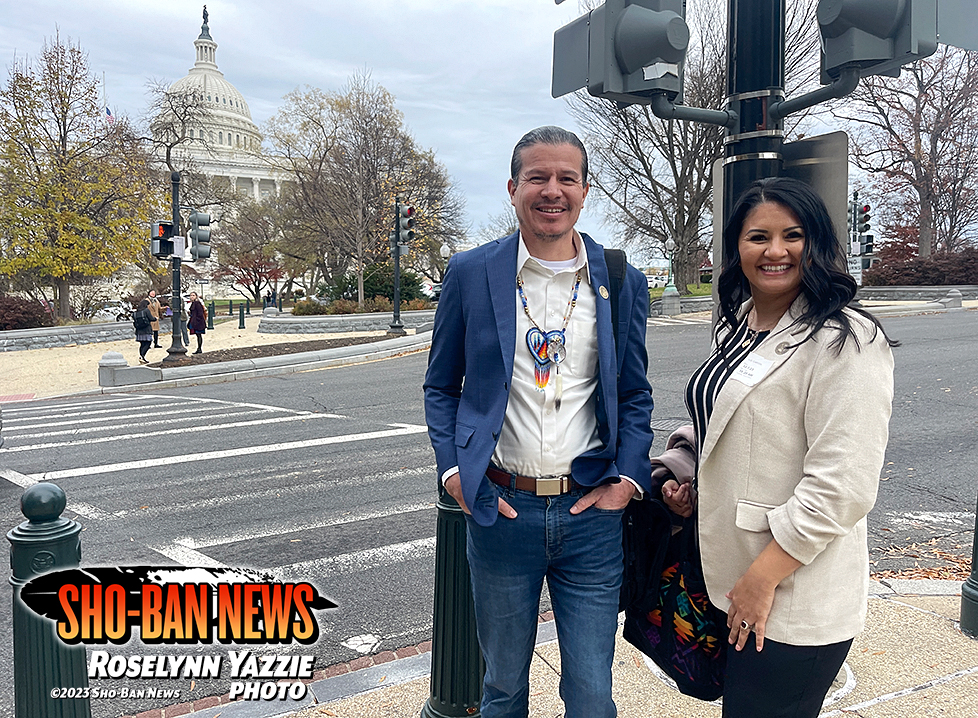
Fort Hall Business Council member Sammy Matsaw Jr. and Shoshone-Bannock Tribes Public Affairs Manager Echo Marshall at the Capitol building on Thursday, December 7.
By ROSELYNN YAZZIE
Sho-Ban News
WASHINGTON — Fort Hall Business Council member Sammy Matsaw Jr. along with Shoshone-Bannock Tribes Public Affairs Manager Echo Marshall toured the U.S. Capitol on Thursday, December 7.
Representative Mike Simpson (R-ID) greeted them outside his office. His intern, Emma Brulotte of Twin Falls, led the tour.
Throughout the day Matsaw attended meetings with Danielle Her Many Horses, Deputy Executive Director of the Indian Gaming Association; the Department of Energy where they got information on some of the potential energy projects and funding. They finished the rest of the day attending the White House Tribal Nations Summit (WHTNS) for various panels at the U.S. Department of the Interior, including listening in on a talk by the Secretary of Transportation Pete Buttigieg and other people from the heads of the Department of Interior.
Earlier in the week, Matsaw and FHBC Vice Chairwoman Donna Thompson, met with Mapetsi Policy Group, the Principal Deputy Assistant Secretary Wizi Garriott, Senator James Risch (R-ID), Senator Mike Crapo (R-ID), attended the NCAI White House Tribal Nations Summit Tribal Leader Briefing, the WHTNS reception, and the Navajo Nation Banquet.
Matsaw explained this was a time for them to meet with all the Idaho delegates and staff to update them on current issues going on with the Shoshone-Bannock Tribes.
He said it’s helpful because they’re taking notes and making sure the issues that are important to the tribes are being taken up to legislation, or are in consideration, and they’re further keeping in touch with how the changes are happening within the tribes and how they’re developing.
Issues range from health care, the fentanyl crisis and economic development, to name a few.
“Those issues are happening in Idaho as a whole, so they’re interested in what’s going on in our community and how they can help. I think that was something I felt really good about coming here and meeting without delegates from Idaho and see how serious they take these issues and how they really meet with us one on one and face to face and they want to know what’s going on in our community,” he said.
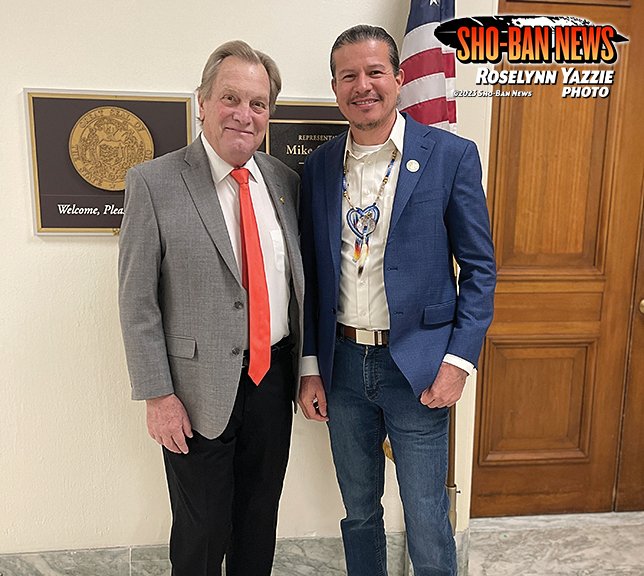
Representative Mike Simpson (R-ID) and FHBC member Sammy Matsaw Jr.
Matsaw attended a senate hearing on fentanyl, which is a big issue in Indian County. The panel included representation from BIA Enforcement, Justice Department, Indian Health Service and the Department of Homeland Security. They informed the Senate Indian Affairs Committee on what are the issues.
“I think really identifying what’s going on with fentanyl in our communities was really important to see how that happens and how it’s happening in front of us and how we’re dealing with the same, almost the exact same issues on the reservation,” said Matsaw.
“I think that was really informative to see how that, how you can champion those issues and you can really get at what’s going on is our communities and start to address some of the things that we’re dealing with in our day to day and what comes before the council as well.”
Matsaw explained to see the tribal leaders in Washington D.C. is to see them meeting with the trustee who has a trust responsibility to tribes and for them to take up those issues and to know who is championing those issues that are going on within their communities.
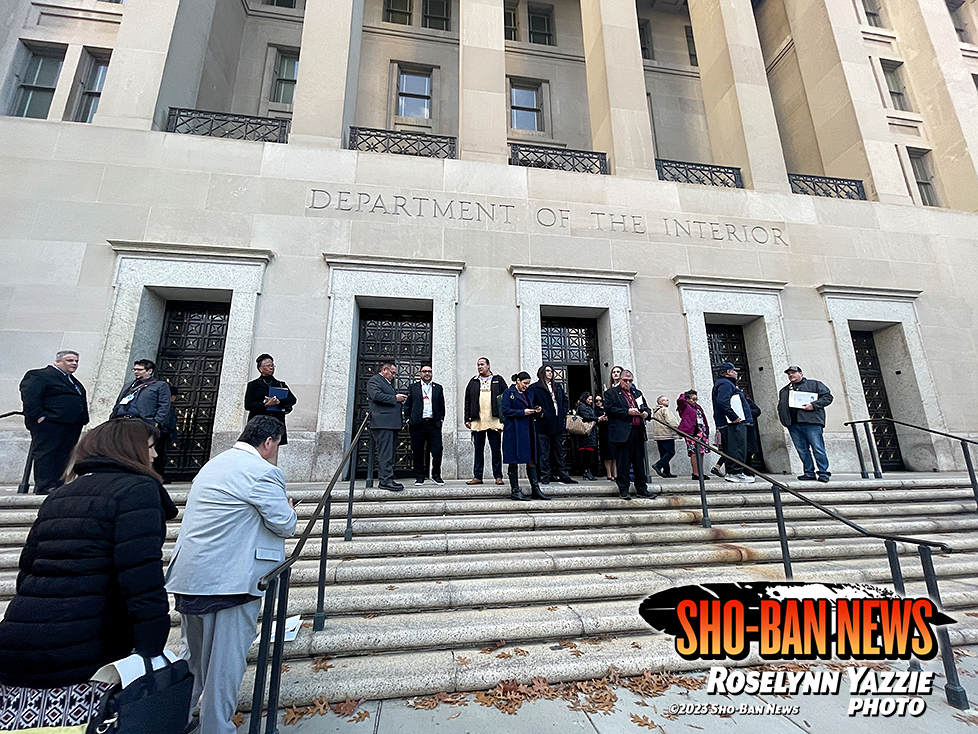
Tribal leaders outside the Department of the Interior on December 7.
“If we don't learn who those champions are we don't know how to support them. If we don't see what’s happening on the ground, boots on the ground, legislation that’s taking place, what’s coming up, what’s on the horizon, it’s hard for us to get prepared for those issues – in order for us to know those things we need to be here in D.C., so that we can get the information from our delegates and legislators from Idaho, as well as people across Indian Country, whether that’s BIA, BIE, the various departments that we interface with, USDA, Forest Service, Department of Energy, education. Whoever they are, we need to meet with them so we get a good idea what’s coming up and they also know what’s coming up with us. I think the back and forth is really helpful so we understand how to communicate and shape some of the policies that are coming up to help people and really bring things home to our tribal membership,” said Matsaw.
Since the WHTNS could only have one leader attend from each tribe, Vice Chairwoman Thompson, represented the Shoshone-Bannock Tribes.
On Wednesday, December 6 she witnessed the opening of the summit and saw remarks given by Secretary of the Interior Deb Haaland. President Joseph R. Biden, Jr. and Vice President Kamala Harris.
Biden spoke about the importance of the summit and the opportunity it provided for a Nation to Nation relationship giving them the chance to reflect on the progress made in recent years and inspiring further conversations about how to move forward in protecting tribal sovereignty.
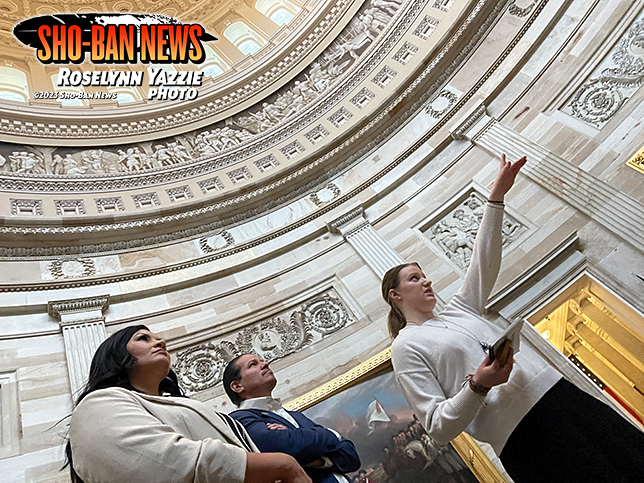
Marshall and Matsaw learn about the history of the Capitol building by Simpson
intern Emma Brulotte.
In a letter to tribal leaders, President Biden wrote, “When I came into office, I was determined to usher in a new era for the relationship between the Federal Government and Tribal Nations. This new era is about respect and partnership It is important to my Administration that we respect Tribal nations as the self-governing sovereigns that they are, that we acknowledge the vital role you play as leaders, and that we listen to you. That's what it means to have a healthy Nation to Nation relationship. It's why we have worked so hard to strengthen and improve Tribal Consultation. And it's why we have been so devoted to partnering with Tribal Nations to build a better future for us all.”
Furthermore, he talked about the Administration’s work in Indian Country like the American Rescue Plan, the Bipartisan Infrastructure Law, and the Inflation Reduction Act, also including billions of dollars to rebuild infrastructure, improve internet access, ensure clean drinking water, combat climate change, creating good paying jobs for Native communities, and partnering with tribal nations to protect sacred sites.
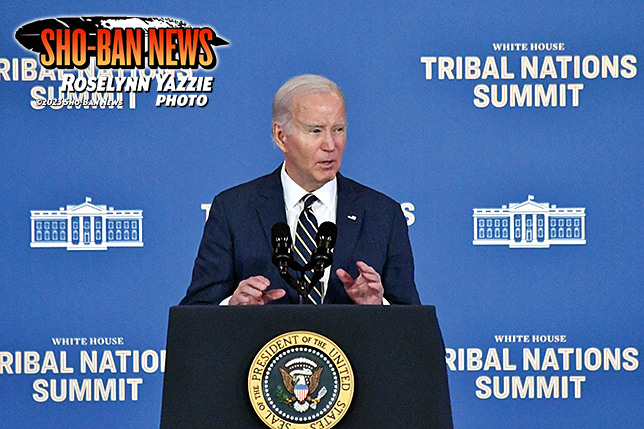
President Joseph R. Biden speaks at the Tribal Nations Summit on December 6.
During his address, President Biden signed an executive order to reform the federal funding system for Tribes, to better serve communities faster by streamlining grant applications, to co-manage federal programs, to eliminate heavy handed reporting requirements, giving tribes more autonomy to make their own decisions and be more efficient.
“Together, these steps are going to help grow Tribal economies and reduce the hoops they have to jump through to get the funding they deserve,” he said.
“It’s all a part of my vision for a new era of respect. Respect for you as leaders, respect for Tribal sovereignty, respect for the Nations’ fundamental right to build a future and own — on your own terms, not anyone else’s terms, not anyone else’s terms,” said Biden.
He closed with saying, “It’s hard work to heal the wrongs of the past and change the course and move forward. But the actions we’re taking today are key steps into that new era of Tribal sovereignty and self-determination — a new era, grounded in dignity and respect, that recognizes your fundamental right to govern and grow on your own terms.”
On the second day of the summit, Thompson spent the day in general sessions with over 500 other tribal leaders.
Thompson said it was really interesting to attend for the first time in the year’s she’s been on the council.
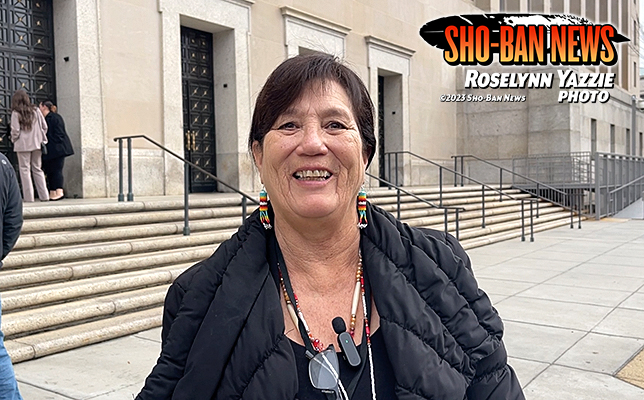
FHBC Vice Chairwoman Donna Thompson at DOI.
“I’m finding it amazing because there’s so much to learn from other tribal leaders and what other tribes have been able to accomplish and where we sit at with our funding levels. What we need to do to go after those funding levels. Biden’s administration has so much funding available to Indian tribes that we need to make sure that we’re capturing it. Not only for public safety, for drug abuse, for housing, for anything that tribes need at this time. We need to be capturing those funds. That’s going to be my main objective of today. Is to take this information back and find out where we’re at in securing some of these available funds for our use,” she said.